Category: Industry receivables · Topic: Freight and logistics documentation readiness · ·
Freight Receivables: What to Organize Before a Commercial Follow-Up
A commercial freight receivables readiness guide for organizing quote, shipment, invoice, exception, and communication context before a business follow-up.
Short answer
Freight debt collection readiness begins with a usable business record: organize the quote or agreement context, shipment record, invoice detail, known exception, and business communication history before a commercial follow-up.

Key Takeaways
- Keep freight invoices, bills of lading, delivery or shipment context, and business communications distinguishable rather than treating them as interchangeable records.
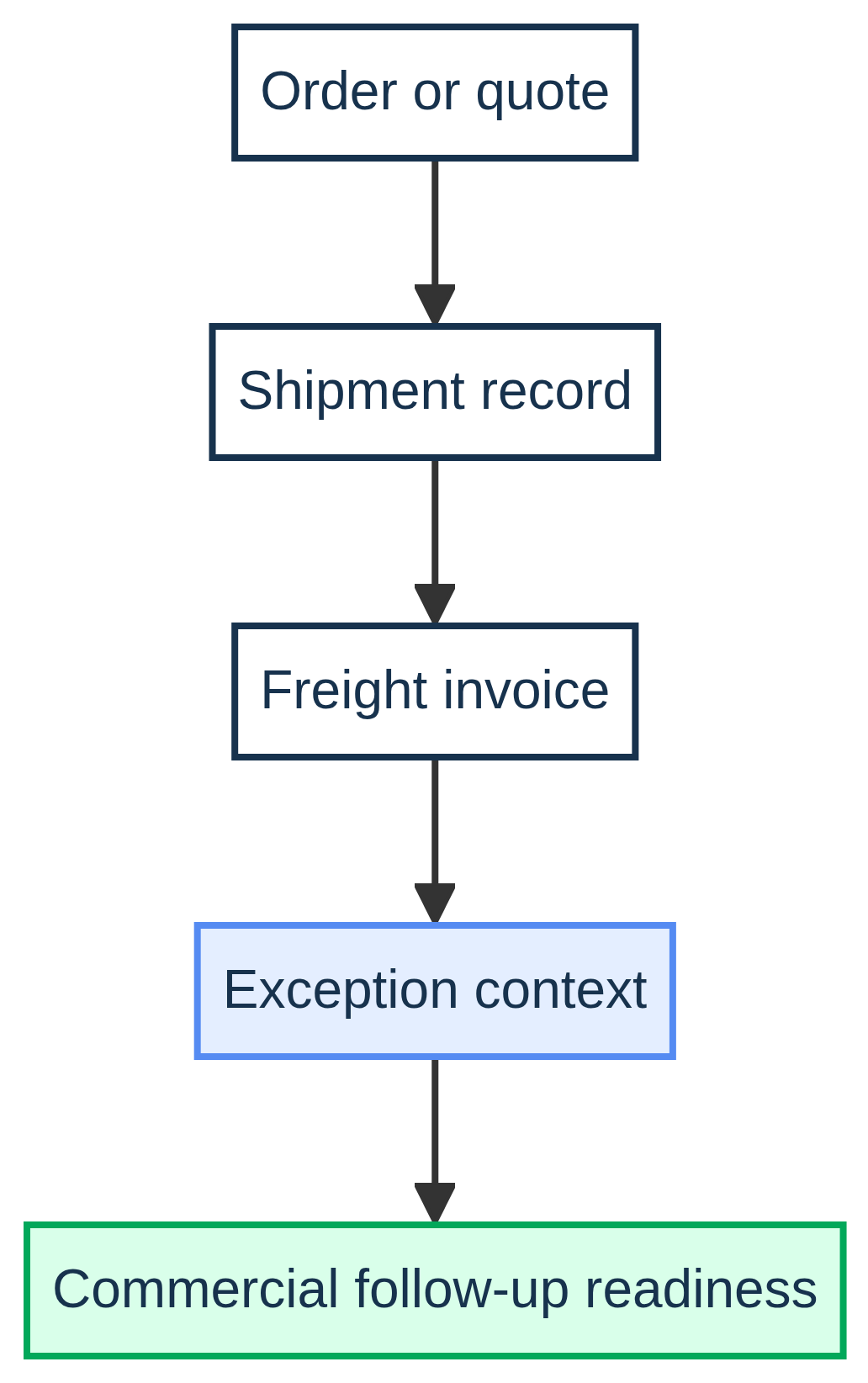
- Build a concise readiness file around the transaction sequence: agreement or quote, charge detail, movement context, exception or deduction context, and internal ownership.
- Log missing documents separately from an open business exception so an internal reviewer can see whether the task is retrieval or review.
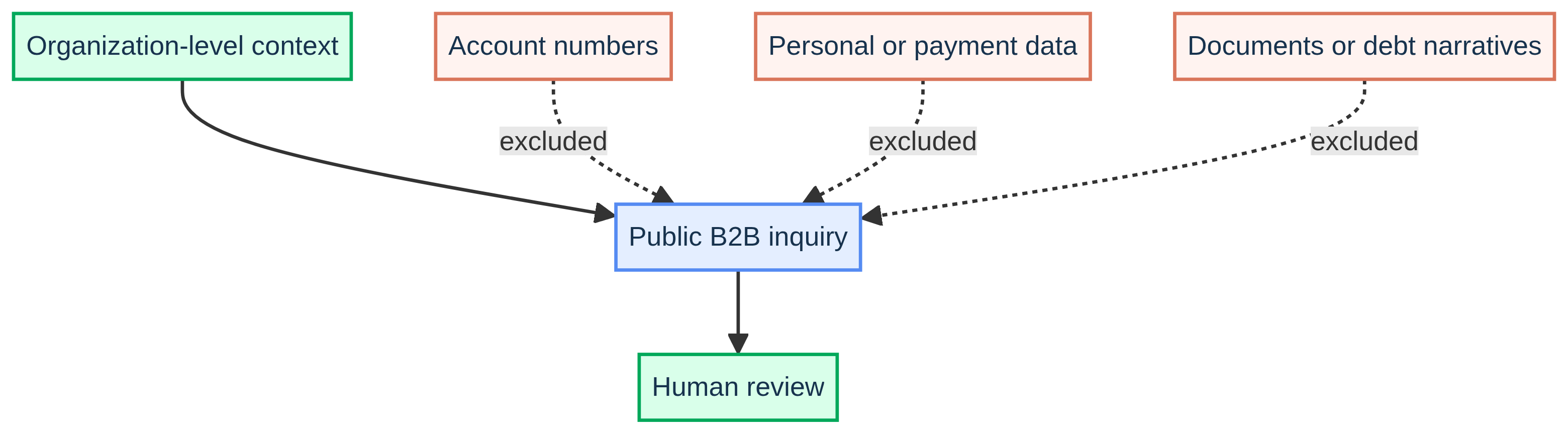
- Use a public B2B inquiry only for organization-level, non-sensitive context. Keep account-level records, payment data, documents, and debt narratives off public forms.
Freight debt collection readiness starts with distinct records
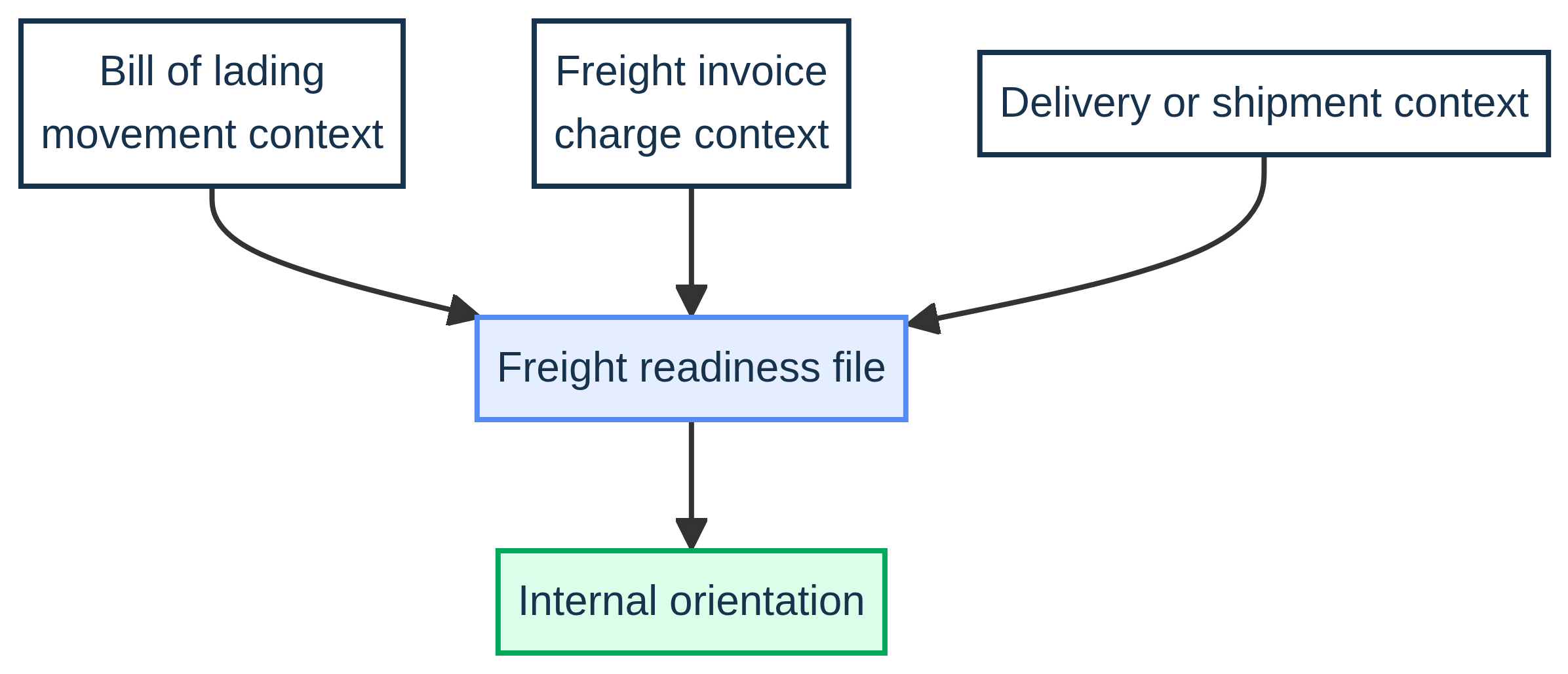
A freight invoice, a bill of lading, and delivery or shipment context can each help a team understand a different part of a transaction. They should be kept distinct before a commercial follow-up. Combining every document into one undifferentiated folder can make it harder for an internal reviewer to tell whether a question concerns movement, charges, a stated exception, or a missing record.
NMFTA’s Bill of Lading vs. Freight Invoices: How They Differ describes the bill of lading and freight invoice as records with different roles: shipment movement on one side, and cost and payment context on the other. That plain-language distinction is useful for organization. It does not mean either record alone proves a claim, resolves a discrepancy, or determines a next step for a particular account.
A bill of lading may be the team’s route to shipment context: the shipment reference, parties named in the business record, handling details, or other movement information that the organization uses. An invoice may be the route to charge context: its reference, date, line items, adjustments shown, and the internal billing status. Delivery or proof context may sit in a separate carrier system, customer portal, scan history, or operating record. The available materials vary by movement type and by an organization’s own workflow.
Treat those variations as a reason to label records by function, not as a reason to invent a universal freight checklist. A short source index can say “quote reference,” “BOL reference,” “delivery context located,” “invoice reference,” or “communication note available.” Each label tells a reviewer where to begin without claiming what the record establishes.
Assemble a compact freight readiness file
The most useful readiness file is small enough to review and specific enough to locate original context. Start with references and owners instead of duplicating every document. A team can keep the source materials in its existing systems while maintaining an internal index that connects the relevant references.
Begin with the agreement or quote context the business already uses. This might be a quote number, rate confirmation reference, customer setup reference, service description, or another internal identifier. Record only enough to identify the transaction path and the person or function who can clarify it. Avoid turning a high-level index into a conclusion about terms or enforceability.
Next, capture invoice and charge detail in descriptive terms: invoice reference, invoice date, charges or adjustments as shown in the billing system, and current internal review status. If the team knows that an item needs confirmation, write that plainly. “Charge detail needs billing review” is more useful than a label that suggests the question has been decided.
Then note the shipment and delivery context that can be found. Depending on the business, that could include a BOL reference, pickup or delivery reference, dispatch record, terminal or carrier system reference, proof-of-delivery context, or a note that the expected material has not yet been located. The record should show the source’s location or responsible function, not paste its contents into a broad-access workspace.
IRS Recordkeeping guidance explains that business purchases, sales, payroll, and other transactions generate supporting documents for business books, and that a record system should suit the business. Applied narrowly here, the useful point is organizational: choose a method your team can navigate and make the supporting records findable. The IRS page does not prescribe a freight receivables file or an action for an individual invoice.
Finally, add the internal business communication context. A compact chronology can include the date, the business function involved, a short topic label, a reference to the source location, and the next internal check. Do not use the chronology as a free-form account narrative. It is a map for collaboration among operations, dispatch, billing, credit, or account management. For broader context, see PayClear’s B2B receivables guide.
Record exceptions and missing documents as separate items
A missing document and an open exception are not the same work item. The first calls for retrieval or confirmation: the team needs to locate a shipment reference, invoice copy, scan record, quote, or communication note, or confirm where it should be held. The second is a business question that needs review by someone who understands the relevant operational or billing context.
An exception or deduction log can keep the difference visible. Use concise, neutral fields such as internal reference, issue type, factual description, related source or missing source, internal owner, prior communication reference, and next internal check. Avoid broad labels such as “resolved” unless the team’s own process has reached that status. The point is to preserve uncertainty where uncertainty remains.
For example, “BOL reference needs location in dispatch records” identifies a retrieval task. “Customer reports an invoice adjustment question; billing review requested” identifies an open business question. Neither entry says more than the team knows. Both show which function is expected to check the next detail.
NACM’s Collections Policy describes commercial credit-policy components that can include account monitoring, collections, disputes, reporting, communication records, and organizing a collection file. That supports an operational practice of separating documentation retrieval from exception review. NACM’s example timing and escalation language is not PayClear policy and is not a timetable for freight follow-up.
A good internal handoff gives each owner a precise question. Operations may help locate movement context. Billing may help locate invoice context. A credit or commercial leader may help coordinate the internal review. Account management may help identify the relevant business communication history. Assigning a question to the function closest to the record is clearer than asking one person to reconstruct every part of a shipment from memory.
Keep the public B2B inquiry within its boundary
A public commercial inquiry is for high-level organization context, not a freight account workspace. It can identify the organization, company-size band, authorized business contact, role or authority, work email, approximate portfolio-balance range, business-purpose receivables category, and brief non-sensitive portfolio context. The aim is to let a person understand the type of business conversation being requested without exposing a specific account file.
Do not place account numbers, personal data, payment data, documents, invoice copies, BOLs, proof-of-delivery materials, customer or account-holder contact details, disputes, complaints, or free-text debt narratives in a public form. Consumer, personally guaranteed, mixed-use, and personal, family, or household debt do not belong in the public B2B inquiry either. Detailed freight materials should remain outside the public form.
This boundary keeps the initial business conversation proportionate. It also means an organization does not need to solve every record question before describing a general commercial workflow need. A high-level inquiry can say that a business has freight-related commercial invoice context and needs a business conversation, without reproducing facts about a shipment or account online.
When a business-level commercial conversation is useful
A business-level conversation can be useful after the team can describe its freight receivables pattern without sharing account-level details. The preparation is practical: identify the organization and authorized contact, state the general business-purpose category, note the approximate portfolio range if known, and summarize the operating question in non-sensitive terms. Keep the underlying readiness file internal until an appropriate process for any further exchange is separately agreed.
This is not a claim that every freight portfolio fits a particular service or that any documentation level produces an outcome. It is simply a way to make the first conversation more intelligible. PayClear’s portfolio process overview similarly frames an initial conversation around portfolio context, operating needs, and human review. When the team has completed that high-level preparation, discuss a commercial portfolio. Use that route only for organization-level business context and not for account records, documents, payments, or personal information.
Consumer account questions use a separate route
This article is for commercial freight teams with business invoice context. It does not apply to consumer accounts or to a person seeking account-specific help. Consumer account questions should use PayClear’s separate minimal Account Information route, rather than a commercial portfolio inquiry. Keep account numbers, payment information, documents, and other sensitive details off public website forms.
Frequently asked questions
What should be in a freight receivables readiness file?
Start with the business’s own references for the agreement or quote, invoice and charge detail, BOL or shipment context, delivery or proof context when available, exception or deduction notes, and a short business communication chronology. The best file structure depends on the organization’s systems. Its purpose is to make context findable for internal review, not to establish a conclusion about a specific receivable.
Is a bill of lading the same as a freight invoice?
No. NMFTA describes the two records as serving different roles: a bill of lading relates to shipment movement, while a freight invoice addresses cost and payment context. Keep both records distinguishable in the readiness file. Their presence does not, by itself, resolve an exception or prove a particular position.
What belongs in a public commercial inquiry?
Use only organization-level, non-sensitive business context: organization name, company-size band, authorized contact and role, work email, approximate portfolio range, business-purpose receivables category, and a brief non-sensitive context statement. Do not include account numbers, personal or payment data, documents, customer details, or a debt narrative.
How should a team handle a missing shipment record?
Treat it as a retrieval task. Record what reference is missing, where the team has checked, and which internal function is closest to the source. Keep that task separate from an open exception so a later reviewer can see whether the record needs locating or a business question needs review.
Sources and limitations
- NMFTA, Bill of Lading vs. Freight Invoices: How They Differ is used only for the plain-language distinction between shipment-movement and freight-invoice roles.
- IRS, Recordkeeping is used only for qualitative context on suitable business recordkeeping systems and supporting transaction documents.
- NACM, Collections Policy is used only for examples of commercial policy areas such as monitoring, disputes, reporting, communication records, and collection-file organization.
These sources support operations and documentation context. They do not support legal advice, rights or remedies, service coverage, recovery claims, payment demands, or recommendations for a specific account.