Category: Collection technology · Topic: Human-reviewed AI workflows · ·
AI-Assisted Commercial Collections: Where Automation Helps and Where People Decide
See where AI-assisted commercial collections can organize routine workflow work and where people should review context, exceptions, and next steps.
Short answer
AI-assisted commercial collections can help a business team organize routine workflow context and prepare next-step work. They should not be treated as a system that independently decides what should happen on a specific account.

AI-assisted commercial collections can help a business team organize routine workflow context and prepare next-step work. They should not be treated as a system that independently decides what should happen on a specific account. The useful line is straightforward: automate repeatable, structured, reviewable work; keep people responsible for interpreting exceptions, relationship context, communications, and the decision to act.
That distinction is not just a matter of tone. NIST’s AI Risk Management Framework says that governance can clarify human roles and responsibilities in human-AI team configurations, while NIST’s generative-AI profile identifies automation bias as excessive deference to an automated system (NIST AI RMF 1.0, S1; NIST Generative AI Profile, S2). For a commercial workflow, that makes human accountability the starting point rather than a late-stage safeguard.
Key Takeaways - Start with repeatable work. Organizing approved context, preparing a summary, and routing work for review are plausible support tasks. - Keep a person at the decision point. An AI output is an input to review, not a substitute for a named owner’s judgment. - Make handoffs visible. Reviewers need source context, a way to recognize uncertainty, and a route for exceptions or overrides. - Evaluate the workflow, not a promise. Teams can define their own clarity, consistency, and handoff questions without assuming an outcome.
What AI-assisted commercial collections should mean in practice
Assistance, not autopilot
In this article, AI-assisted commercial collections means human-reviewed workflow support. A system may organize approved business context, identify missing process fields, prepare a short recap, or place work in a review queue. A person then determines whether that output is accurate, relevant, and appropriate for the situation.
That is deliberately narrower than describing AI as an autonomous collections decision-maker. A prepared summary can omit a material detail. A pattern can be based on incomplete context. A suggested sequence may not fit the relationship a business wants to preserve. NIST’s two publications are useful here because they treat the human-AI configuration, assigned roles, and appropriate oversight as design considerations rather than assumptions (NIST AI RMF 1.0, S1; NIST Generative AI Profile, S2). They do not prescribe a commercial receivables process or validate a particular platform.
The commercial boundary matters as well. This is an operational discussion for business owners and authorized decision-makers. It is not a consumer account path, a payment process, or a place to share account-level records in public.
Use a workflow lens, not a feature list
A feature list can obscure the real question: Which recurring task is structured enough to support, and where must a person make the call? A practical workflow lens is: assemble context, prepare work, review it, decide the next action, and learn from exceptions. Each stage gives a team a chance to assign a clear owner.
For broader background on technology supporting organized receivables processes, see PayClear’s technology-assisted collection workflows. This article takes the narrower view: the value of assistance depends on a visible handoff to human judgment.
Where automation has a practical job

Automation is most useful when the input, output, and review step are defined before the tool is used. That keeps the technology in a support role and gives a reviewer a specific piece of work to assess.
Organizing workflow context
At a high level, a workflow can bring together approved business information, apply consistent labels, identify process fields that are absent, and make a portfolio-level queue easier to scan. The point is not to create a self-driving process. It is to reduce the effort required to assemble material that a person already needs for review.
Oracle NetSuite’s general AR automation explainer describes recurring process categories such as invoicing, reminders, reconciliation, and reporting, and notes that businesses set messaging timing and content and decide when people enter the process (Oracle NetSuite, S7). That is a useful illustration of a routine process layer, not evidence of any PayClear feature or commercial outcome.
The boundary is important: “organize context” refers to work inside an approved workflow. It does not invite a visitor to paste account details, personal information, or documents into a public web form. A public inquiry can establish business purpose and operating context at a high level; account-specific information belongs only in an appropriate, agreed channel later.
Preparing summaries, notes, and handoffs
Preparation is another reasonable support category. A tool may draft a concise recap of an approved interaction record, surface stated next actions for a reviewer, or retrieve relevant internal procedure content for consideration. Those outputs can save a reviewer from starting with a blank page, but they still require a check for accuracy, omissions, and fit with the actual business context.
CGI identifies call summarization, real-time agent guidance, and in-workflow inquiry as assistive collections use cases, and it describes phased adoption that begins with lower-risk assistance (CGI, S8). That vendor material includes consumer-collections framing and performance claims that are not relevant here. Its descriptive use-case categories are the limited point: preparation can support a person without assigning the person’s responsibility to software.
A useful handoff states what the tool prepared, what source context the reviewer should inspect, and what the reviewer is expected to decide. If the summary cannot be traced back to the approved context, it should not be treated as sufficient on its own.
Prioritizing attention, not deciding the outcome
A workflow may sort or flag items using agreed operational signals. That can focus attention, especially when a team needs to decide what to examine first. The output should remain a review queue, not a final instruction or an account-specific result.
This distinction prevents a category error. A pattern may help a reviewer ask, “What context should I examine?” It cannot resolve every missing fact, relationship consideration, or exception that is not represented in the available material. Teams should therefore define what a flag means, what it does not mean, and who can change the order or set it aside.
Where people decide
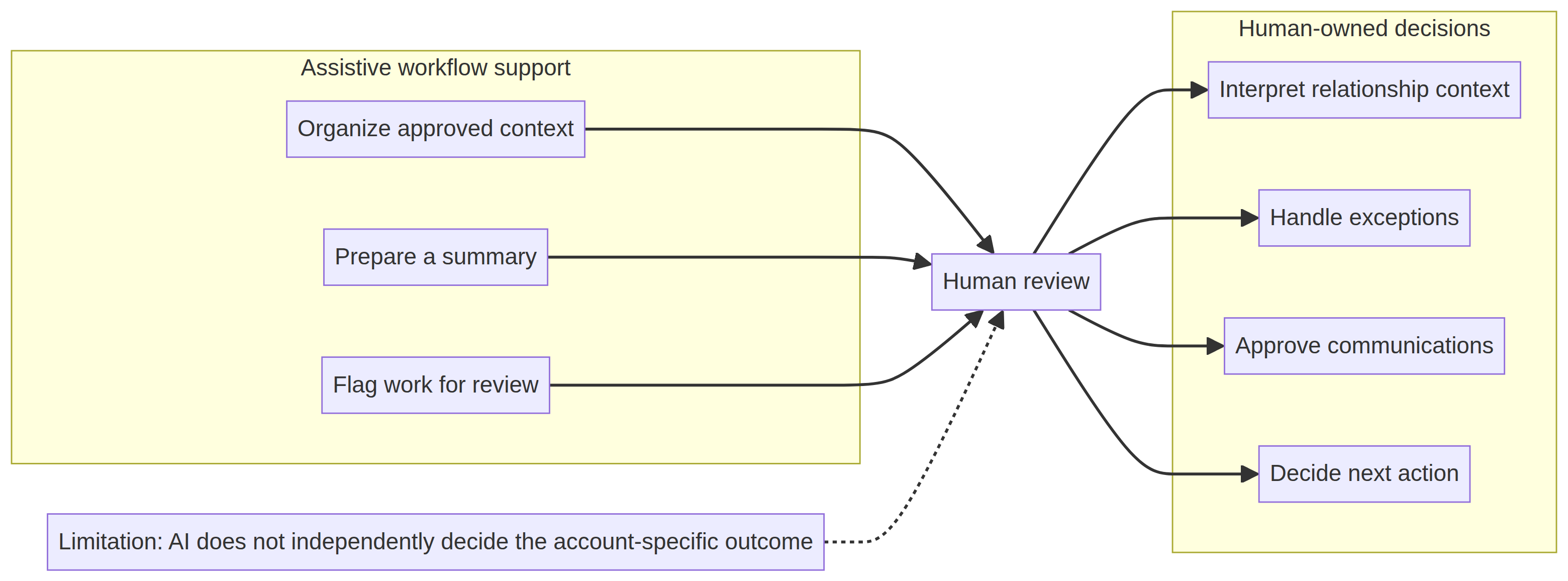
People should own the moments where the work turns on context, ambiguity, or accountability. Technology can make those moments easier to prepare for; it should not be presented as resolving them independently.
Relationship context and exceptions
Commercial receivables work can call for an informed view of the business relationship, the available record, a changed contact path, or a fact that does not fit the routine workflow. This article does not interpret those situations or advise on what any organization should do. It identifies them as decision points that should reach a responsible person.
A reviewer may need to decide whether the available context is complete enough for a next action, whether a matter is an exception, whether a prepared sequence makes sense, or whether the work should go to a different internal owner. Naming that responsibility makes the system’s boundary visible. It also makes it less likely that an AI-generated suggestion will acquire authority merely because it appears in a queue.
Communications and the next action
A person should approve the next action and take responsibility for communication choices. AI can retrieve context or prepare a draft for consideration, but the accountable owner can accept, change, defer, or reject the suggestion before acting.
The OECD’s AI Principles discuss context-appropriate human agency and oversight, meaningful information about capabilities and limitations, accountability, traceability, and the ability to override, repair, or decommission systems when appropriate (OECD, S6). Those are policy principles, not a commercial collections rulebook or a statement about PayClear. As a design prompt, they support a simple operating habit: the person with responsibility must be able to disagree with the output.
Accountability needs an override path
Human review is meaningful only when it has a practical path to change the workflow. Give reviewers a named owner, the source context that informed the suggestion, a place to mark the output incomplete or wrong, and an exception route that does not disappear into an undifferentiated queue.
That path also distinguishes review from rubber-stamping. If a reviewer can see why a suggestion appeared but cannot pause, correct, or redirect it, the system has blurred the line between assistance and decision. An operational design should keep the final judgment with the person assigned to make it.
Design the handoff before adding more automation
Define the job and the decision boundary
Begin with a plain-language description of the task: what approved information is used, what output is prepared, who receives it, and what a person must decide. Then add one equally plain sentence: this is not the system’s job. For a summary aid, that might mean it does not determine whether the summary is complete. For a routing aid, it might mean it does not decide the appropriate next action.
NIST’s AI RMF identifies GOVERN, MAP, MEASURE, and MANAGE as four functions, with GOVERN cross-cutting, and it notes the role of clarifying responsibilities in human-AI configurations (NIST AI RMF 1.0, S1). Those labels can be a planning lens for assigning roles and boundaries. They are not an implementation checklist or a claim that an organization follows a NIST program.
Give the reviewer enough context to disagree
A reviewer needs more than a confidence-sounding label. The review surface should show the relevant approved business-source context, indicate what is missing or uncertain when feasible, and allow the person to mark the output wrong, incomplete, or not useful. Context turns an opaque recommendation into something a person can evaluate.
Google PAIR’s People + AI Guidebook covers mental models, trust and explanations, feedback and controls, and errors and graceful failures; it also says people prefer to remain in control of what tasks tools execute, how, and to what end (Google PAIR, S5). Microsoft’s Human-AI Interaction guidance similarly organizes its evidence-based guidance across initial use, interaction, errors, and ongoing use (Microsoft, S4). Both are general product-design resources, not receivables-specific instruction, but they reinforce the value of clear controls and usable failure paths.
Build an exception route and feedback loop
Exceptions should go somewhere specific: a named person or a defined team path. Record why a suggestion was changed, deferred, or rejected, then look for recurring gaps in the workflow. The aim is operational learning about inputs, handoffs, and review questions, not an assertion that a system will continuously learn or improve on its own.
GAO’s accountability framework organizes its discussion around governance, data, performance, and monitoring, with lifecycle-oriented practices for entities considering and monitoring AI systems (GAO, S3). It was developed for federal agencies and other entities, not as commercial receivables guidance. A business team can still use those four headings as a lightweight way to ask whether ownership, data context, review quality, and follow-up have been considered.
Questions a business team can ask before using AI support
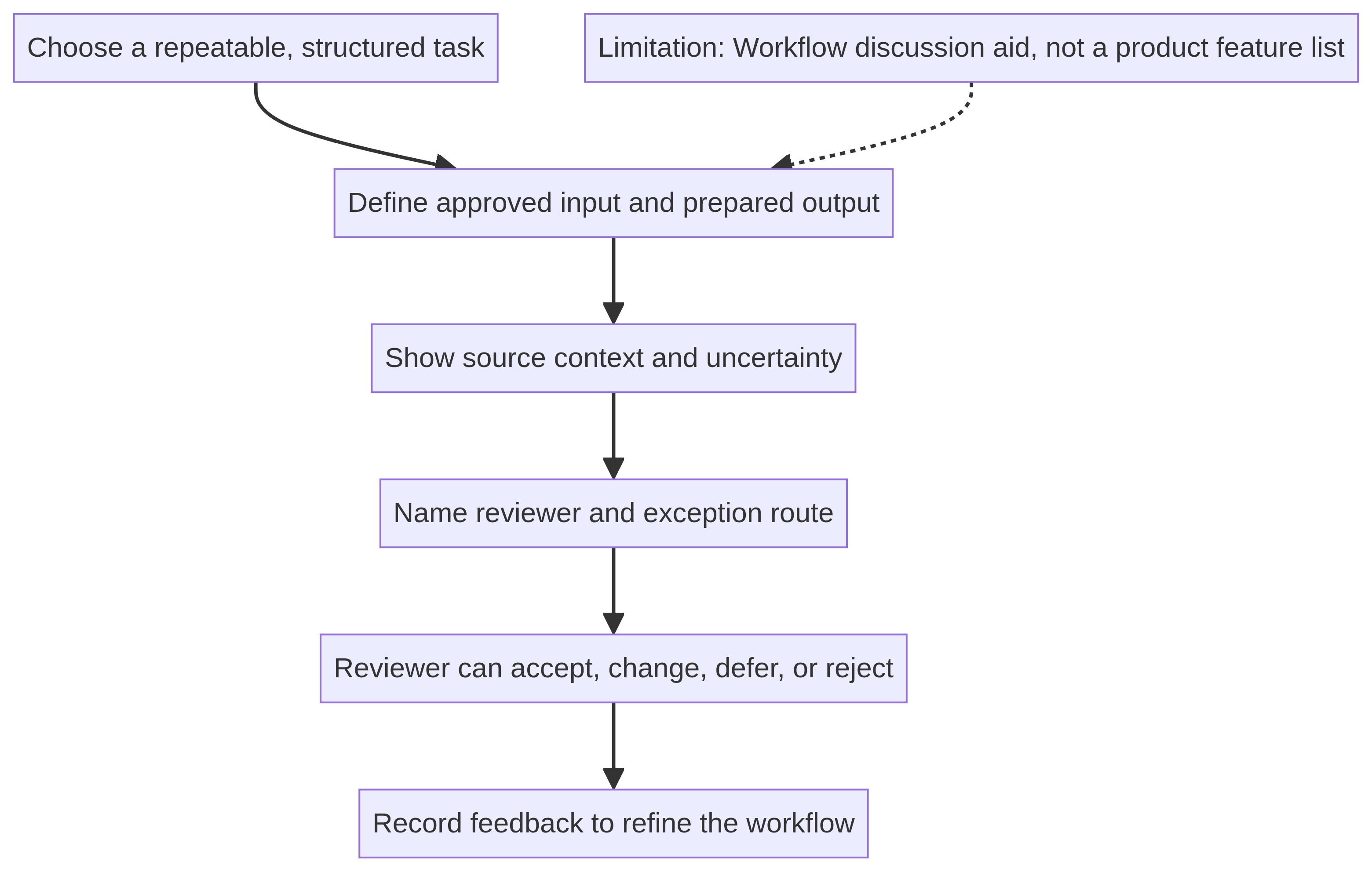
A sensible first step is a narrow workflow conversation, not an assumption that more automation is automatically better. The following questions keep that conversation anchored in the work:
- Which repeated task is structured enough to support without turning the tool into a decision-maker?
- What approved business-source context will the reviewer see with each suggestion?
- Which situations should always be routed to a person or exception path?
- Who owns the review, the exception decision, and the feedback record?
- How will the team describe a useful result in operational terms, such as clearer context or more consistent handoffs, rather than a promised outcome?
- What sensitive or account-specific information is outside the public inquiry process?
For related preparation ideas, PayClear’s guide to organizing B2B receivables context discusses record and ownership clarity. A team considering a general workflow conversation can also review how a commercial workflow evaluation can begin. Neither resource determines the right approach for a specific matter.
Discuss the workflow at a business level
If your organization is evaluating a more structured commercial receivables workflow, you can start a business-level commercial receivables conversation after considering the review and handoff questions above. The public inquiry is business-level only. Do not submit account numbers, consumer identifiers, payment information, documents, or other sensitive details. It is not a payment, account-detail, or legal-advice channel.
Conclusion
The productive question is not whether software or people should “win” a commercial workflow. It is which recurring work is structured enough for assistance and which decision requires accountable human judgment. Organizing, preparing, and routing can make review easier when their limits are clear. Context, exceptions, communications, and next actions remain human-owned decisions.
This is an operational lens, not an outcome claim or a prescription for a particular matter. For broader context, explore PayClear’s commercial receivables technology resource.
Frequently asked questions
What tasks can AI assist with in a commercial collections workflow?
Depending on the system and the organization's approved process, AI may help organize permitted workflow context, prepare summaries or handoffs, and direct routine work for review. Those examples are evaluation questions, not a claim that every tool provides them or that any account outcome will follow.
Should AI decide whether a commercial account is valid or what action to take?
No. The article's operating boundary is that AI outputs are inputs to accountable human review. People remain responsible for interpreting context and exceptions and for deciding whether and how an appropriate next step is taken.
What should a business ask about human oversight?
Ask what source context a reviewer sees, who owns the decision, which exceptions go to a person, how a reviewer can disagree or override a suggestion, and how changes or unresolved questions are recorded.
Does AI-assisted technology guarantee faster recovery or a specific ROI?
No. This article makes no recovery or ROI promise. An organization would need to define its own workflow, baseline, data, costs, measurement window, and review process before evaluating an operational result.
Sources
- S1 — National Institute of Standards and Technology. Artificial Intelligence Risk Management Framework (AI RMF 1.0), January 2023. Cited for the framework functions and the role of clarifying human responsibilities in human-AI configurations.
- S2 — National Institute of Standards and Technology. Artificial Intelligence Risk Management Framework: Generative Artificial Intelligence Profile, July 2024. Cited for automation-bias and oversight context.
- S3 — U.S. Government Accountability Office. Artificial Intelligence: An Accountability Framework for Federal Agencies and Other Entities (GAO-21-519SP), June 30, 2021. Cited for governance, data, performance, and monitoring as an accountability lens.
- S4 — Microsoft HAX Toolkit / Microsoft Research. Guidelines for Human-AI Interaction, reviewed October 4, 2026. Cited for its lifecycle-oriented human-AI interaction guidance.
- S5 — Google People + AI Research. People + AI Guidebook, updated May 24, 2024. Cited for controls, feedback, explanations, and graceful failures.
- S6 — Organisation for Economic Co-operation and Development. AI Principles, updated 2024. Cited for human agency, oversight, transparency, accountability, and override concepts.
- S7 — Oracle NetSuite. Accounts Receivable (AR) Automation: A Complete Guide, reviewed October 4, 2026. Cited only as a general AR automation example.
- S8 — CGI. AI in debt collections: 3 use cases that move KPIs, reviewed October 4, 2026. Cited only for descriptive assistive use-case categories.