Category: Commercial debt recovery · Topic: Vendor evaluation · ·
How to Choose a Commercial Debt Collection Agency
Use a practical checklist to compare commercial collection agencies by B2B fit, workflow, reporting, information handling, technology, and terms.
Short answer
Choosing a commercial debt collection agency starts with a written view of the business receivables work your organization needs help with, the information it can appropriately provide, the working relationship it expects, and the reporting it needs back. Compare prospective partners against that same brief.
Choosing a commercial debt collection agency starts with a written view of the business receivables work your organization needs help with, the information it can appropriately provide, the working relationship it expects, and the reporting it needs back. Compare prospective partners against that same brief. A headline claim, a generic ranking, or a low quote alone does not show whether an operating model fits your team.
This is a practical evaluation guide for business-purpose receivables and authorized organizational decision-makers. It is not consumer, legal, tax, state-coverage, or account-specific guidance. If the portfolio might involve personal, household, mixed-use, or other uncertain matters, do not use this article or a public business form to decide its classification. For broader context on preparing a business receivables conversation, see PayClear’s B2B receivables overview.
Key Takeaways - Start with your operating requirements: receivables category, available records, internal owners, approvals, and reporting needs. - Give each candidate the same business-level brief and ask for the same operating evidence, rather than comparing assurances or price in isolation. - Treat information access, portals, automation, and AI as workflow questions: ask what is shared, who can see it, what people review, and how exceptions surface. - Record what is known, what remains open, and how reporting, terms, and change management would work before a decision is made.

Build your business brief before contacting agencies
A useful comparison begins before the first outreach. Prepare a private internal brief that describes the receivables category, whether the counterparties are businesses, the documentation available, prior outreach at a high level, the internal owner, desired update cadence, and approval or escalation expectations. The purpose is not to turn a public conversation into an account review. It is to give prospective partners enough organization-level context to explain how their model might fit.
Keep the first online conversation high level. Do not paste account numbers, consumer identifiers, payment information, documents, or other sensitive details into a public form. The FTC’s business guidance recommends that organizations know what information they have, limit what they retain, and examine outsourced providers’ practices; those are sensible information-handling questions, not a collection-agency rule or a substitute for qualified advice (FTC, Protecting Personal Information: A Guide for Business).
Your internal brief can also draw on the preparation work in PayClear’s guide to organizing the balance, ownership, and prior outreach. Keep any detailed records in an appropriate internal or agreed channel. The public question is simply whether a prospective partner can explain its business-purpose workflow clearly enough for your team to evaluate it.
Use a commercial collection agency evaluation checklist
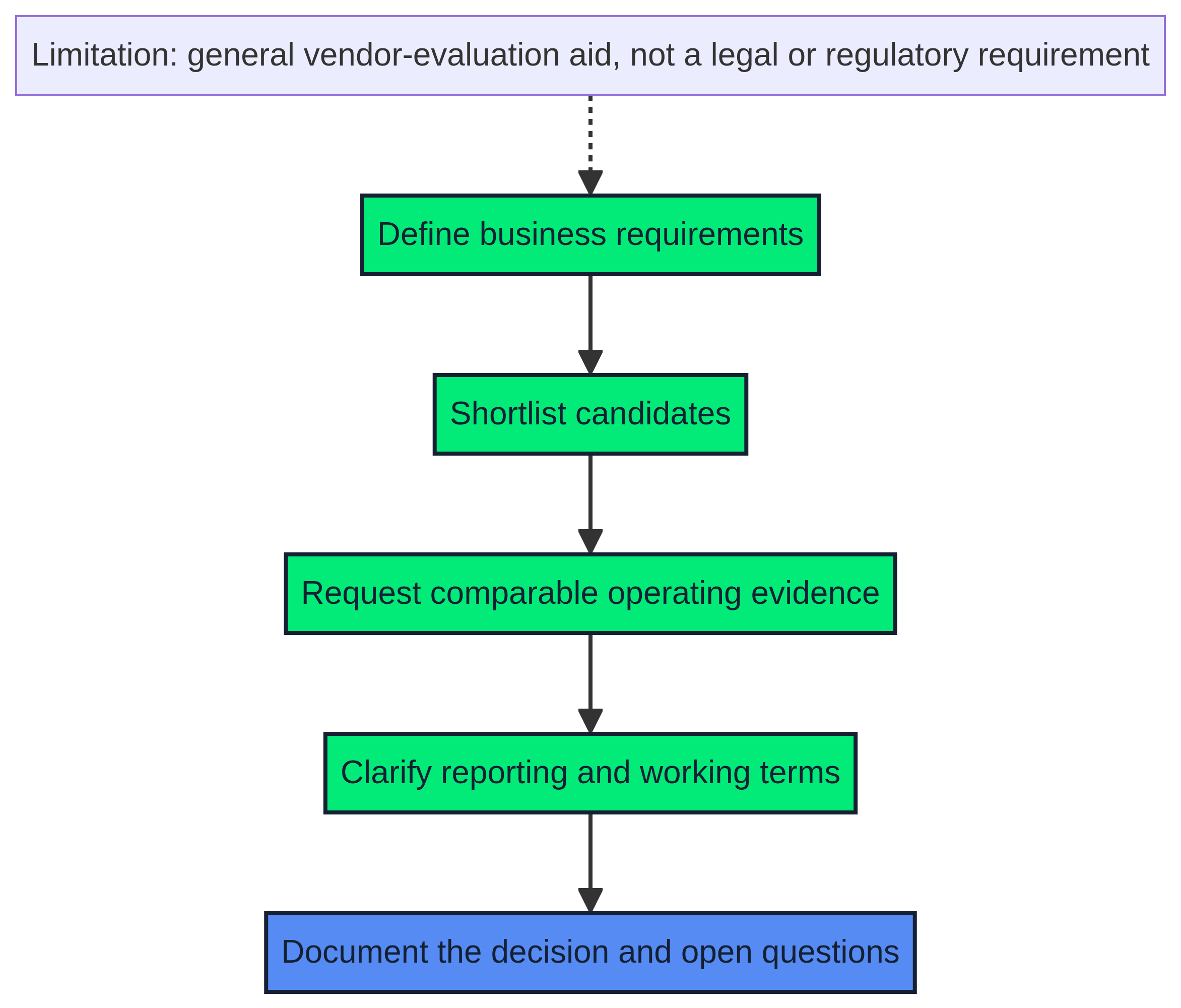
The checklist below is a set of comparison questions, not a list of guarantees. No single answer proves that an agency is the right fit, and no public guide can determine how a particular matter should be handled. The aim is to make each candidate’s operating model visible enough to compare on the same basis.
Confirm commercial fit and relevant experience
Start by asking whether the candidate’s examples, staffing, communication model, and reporting approach are relevant to business-to-business receivables like yours. Request anonymized or high-level examples of comparable operating situations, not confidential client files. Ask which roles would interact with your organization and how the candidate distinguishes a commercial workflow from other portfolio types.
The Federal Reserve’s bank-oriented third-party guidance lists business experience, key personnel, financial condition, information security, and monitoring among due-diligence considerations. For a commercial buyer, it is a transferable way to organize questions, not a requirement imposed on your organization (Federal Reserve, Interagency Guidance on Third-Party Relationships). Industry credentials can be a lead to verify, but not a conclusion: CLLA describes its certification program as voluntary (CLLA, Certified Commercial Collection Agencies).
Send the same written requirements to every candidate
Use one short, business-level brief for each candidate and record the response in one comparison sheet. Include portfolio-level scope, internal contacts, expected handoffs, reporting needs, systems involved, and your approval points. When every candidate responds to different questions, the differences in the answers can be impossible to interpret.
Price is part of a commercial proposal, but it should not be the only comparison field. Federal procurement standards offer a useful high-level analogy: capability, experience, resources, organization, controls, and performance record may all matter alongside price (Acquisition.gov, FAR Subpart 9.1—Responsible Prospective Contractors). That is not private-contract advice. It is a reason to make your own selection record broad enough to capture the operating facts your organization needs.
Ask how the working relationship will be represented
Ask who would be the day-to-day contact, what a normal status update includes, when an issue moves through an escalation path, and how questions from your team are handled. A prospective partner should be able to describe its communication approach in plain operational language. Ask for an example of workflow vocabulary or a non-confidential status-report format, not account-specific transcripts or recordings.
This question matters because the operating style needs to fit the relationships and approvals your organization wants to preserve. NACM’s third-party-agency guidance identifies transparent operations, reporting access, and relevant specialization as areas buyers can evaluate (NACM, Guidelines for choosing a third-party collections agency). Use that industry perspective to shape questions, not to infer that any particular model or provider will produce a given outcome.
Clarify roles, handoffs, and the exception path
Before choosing a partner, ask what happens after a business-level onboarding decision. Who reviews the submitted portfolio context? Who owns a workflow exception? Who at your organization can pause or redirect work? How is a problem surfaced and documented? Here, an “exception path” means an internal operational route for questions or changes. It does not mean litigation, legal action, or a promised result.
The OCC describes a third-party relationship life cycle that includes planning, due diligence, contract negotiation, ongoing monitoring, and termination. Because that guidance is for banking organizations, use it only as a vendor-management pattern: make roles and expectations clear, then revisit them as the relationship changes (OCC, Third-Party Relationships: Interagency Guidance on Risk Management). Name contacts, approval boundaries, and the path for questions before sensitive operational details are exchanged.
Review information handling and access before sharing records
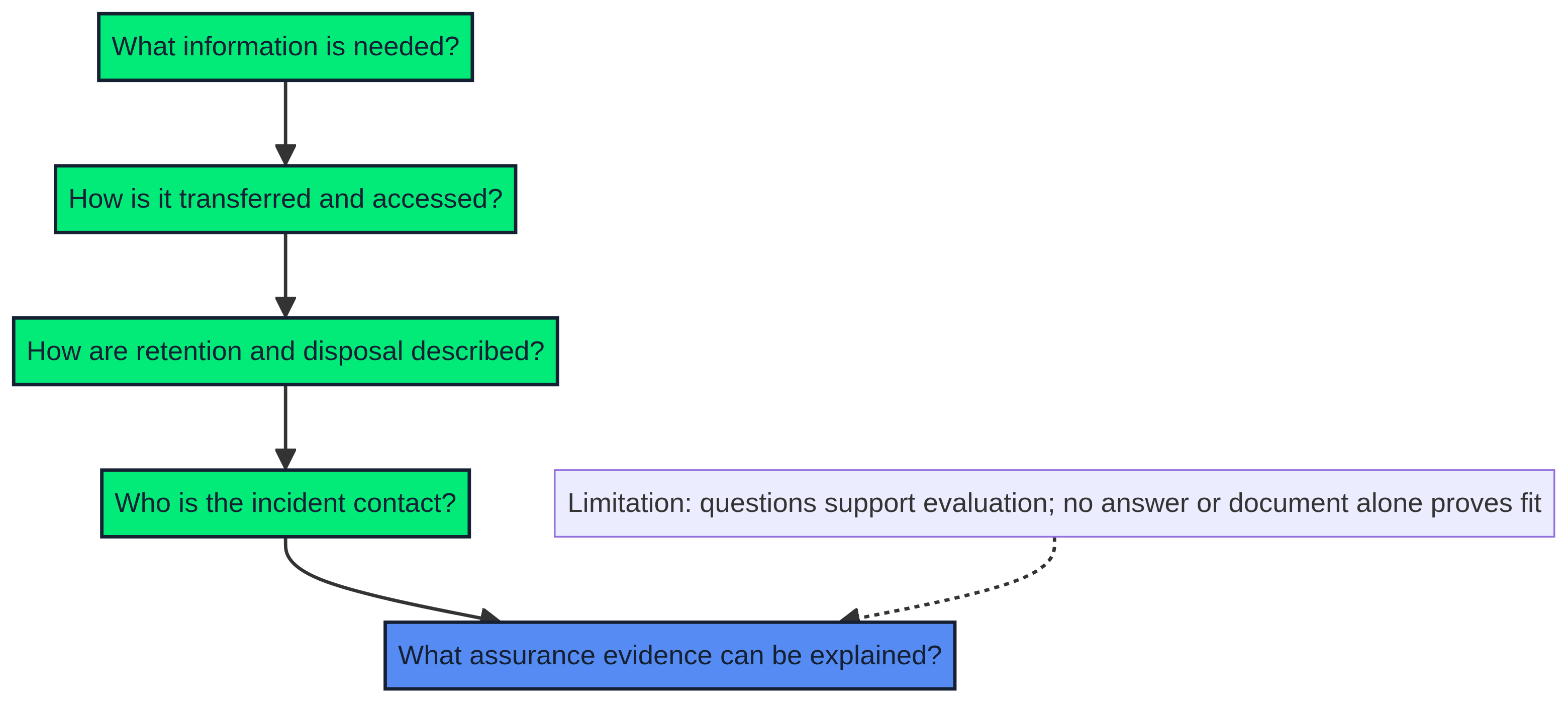
Ask what information is needed at each stage, how it would be transferred, who can access it, how access roles are managed, how long information is retained, and whom your team would contact if an incident were reported. Ask whether the candidate can explain its retention or disposal approach and provide relevant assurance material. Do not assume that one document or one answer proves a workflow is appropriate for every organization.
NIST’s supply-chain guidance supports setting and communicating requirements for technology products and services, while the FTC advises organizations to investigate outsourced providers’ security practices and arrange for incident notice (NIST, CSF 2.0 Quick-Start Guide for C-SCRM; FTC). AICPA describes SOC services as assurance reports that can help users assess outsourcing risk; a SOC report is not a universal requirement or proof of fit (AICPA & CIMA, SOC Suite of Services).
Ask specific questions about portals, automation, and AI
A feature list is not a decision framework. Ask what the portal shows, which roles can see which records, whether exports can be controlled, which steps are automated, how changes or errors surface, and which exceptions receive human review. The answers should make the working process more understandable, not become an unsupported prediction about recovery, speed, or accuracy.
NIST characterizes its AI Risk Management Framework as voluntary guidance for incorporating trustworthiness considerations into the design, development, use, and evaluation of AI products, services, and systems (NIST, AI Risk Management Framework). For a buyer, that supports asking how an AI-enabled workflow is governed, used, evaluated, and reviewed. AI may organize context or routine work; people remain responsible for judgment, exceptions, and account-specific decisions. For PayClear’s own description of this support model, see how PayClear describes technology-assisted workflow support and its related discussion of AI-assisted collection workflows.

Agree on reporting definitions before comparing performance
Request a reporting sample and agree on the definitions that would make it useful: portfolio status categories, a consistent placement reference, action notes at the right access level, update cadence, and a route for questions. If your team wants to track operating efficiency or cash-flow context, first agree on source data, definitions, time window, and cost treatment. A portal alone is not evidence of decision quality, and a reporting view is not a real-time guarantee.
The Federal Reserve guidance treats ongoing monitoring as part of a third-party relationship life cycle, which is another useful planning lens rather than a mandate for commercial buyers (Federal Reserve). PayClear’s commercial workflow overview provides a process-oriented next step; use it to understand the stated workflow, not to assume an outcome for any portfolio.
Make commercial terms and change management understandable
Ask for a plain explanation of the proposed scope, fee basis, possible additional costs or handoffs, reporting or remittance timing as proposed, review points, and what happens if the scope changes. Record what each candidate has included, what it has not included, and which questions remain unresolved. Have qualified internal stakeholders review terms in the way that is appropriate for your organization; this article does not interpret contracts or advise on rights.
Also ask how a material change in portfolio condition, systems, process, or staffing would be identified and communicated. The Federal Reserve guidance includes financial condition and ongoing monitoring in its due-diligence frame, while the procurement reference emphasizes looking beyond price alone (Federal Reserve; Acquisition.gov). For commercial buyers, the practical point is modest: understand the proposed operating capacity and change path in proportion to the exposure you are considering.
Turn the checklist into a documented decision
A short decision record keeps a comparison from becoming a set of vague impressions. Give each candidate a row and use the same fields: commercial fit, proposed operating contact, requested evidence received, information-access answer, technology and human-review answer, reporting sample, terms understood, change path, and unresolved questions. Do not force a score where the evidence does not support one. An unanswered question is an unknown, not a positive signal.
The record is also useful for deciding whether a scoped conversation would clarify the working fit. Keep any early conversation at the organization and portfolio level. Move sensitive information only through an appropriate, agreed channel after your organization understands why it is needed and who will receive it. This turns selection into a documented business judgment rather than an attempt to predict a result.
Start a commercial receivables conversation when your requirements are clear
If your organization has prepared a business-level view of its commercial receivables workflow, you can start a commercial portfolio conversation with PayClear after the checklist has helped you frame the right questions. The public inquiry is business-level only. Do not include account numbers, consumer identifiers, payment information, documents, or other sensitive details. It is not a payment portal, a legal service, or an account-specific review, and it does not promise acceptance, placement, coverage, timing, or a recovery result.
Frequently asked questions
What should an organization compare when choosing a commercial debt collection agency?
Compare candidates against the same written business brief. Review commercial fit, proposed roles and handoffs, reporting definitions, information-access and handling practices, technology and human-review answers, commercial terms, and the process for changes or exceptions.
Should price be the only selection criterion?
No. Price is one part of the commercial terms. A consistent comparison should also capture workflow fit, responsibilities, reporting, information handling, operating capacity, and unresolved questions so a lower quote is not mistaken for a complete fit assessment.
What belongs in an initial public business inquiry?
Keep it organization-level and use only the fields requested by the form, including a fixed-list workflow topic. Do not include account numbers, consumer identifiers, payment information, documents, disputes, or a free-text account narrative.
Does an agency-selection checklist guarantee compliance or recovery?
No. A checklist helps an organization structure its evaluation; it does not certify a provider, determine legal compliance, decide whether an account should be placed, or predict payment or recovery.
Sources
- S1. Office of the Comptroller of the Currency, Third-Party Relationships: Interagency Guidance on Risk Management, 2023.
- S2. Board of Governors of the Federal Reserve System, Interagency Guidance on Third-Party Relationships, 2023.
- S3. U.S. Acquisition.gov, FAR Subpart 9.1—Responsible Prospective Contractors, retrieved 2026-10-04.
- S4. National Institute of Standards and Technology, NIST Cybersecurity Framework 2.0: Quick-Start Guide for Cybersecurity Supply Chain Risk Management, 2024.
- S6. Federal Trade Commission, Protecting Personal Information: A Guide for Business, retrieved 2026-10-04.
- S7. AICPA & CIMA, System and Organization Controls: SOC Suite of Services, retrieved 2026-10-04.
- S8. National Institute of Standards and Technology, AI Risk Management Framework, 2023.
- S10. National Association of Credit Management, Guidelines for choosing a third-party collections agency, 2026.
- S11. Commercial Law League of America, Certified Commercial Collection Agencies, retrieved 2026-10-04.