Category: Commercial debt recovery · Topic: Commercial collections basics · ·
What Is Commercial Debt Collection? A Business Owner's Guide
Learn what commercial debt collection means, how a business receivables workflow is organized, and what to prepare before evaluating outside support.
Short answer
Commercial debt collection is the organized work a business uses to address overdue business-purpose invoices or other receivables. It can include internal follow-up and issue resolution, or a conversation about outside workflow support; it does not promise that any balance will be recovered.
Commercial debt collection is the organized work a business uses to address overdue business-purpose invoices or other receivables. It can include internal follow-up and issue resolution, or a conversation about outside workflow support; it does not promise that any balance will be recovered.
Key Takeaways - Commercial debt collection concerns documented business-purpose receivables, including overdue invoices for goods or services. - Clear records, ownership, communication history, and documented follow-up make a receivables conversation easier to organize. - Internal follow-up and outside support are different operating choices; neither is automatically right for every business context. - Public inquiries should stay at the organization level. Do not put account numbers, consumer identifiers, payment information, documents, or other sensitive details in a public form.

This guide is for owners, finance leaders, and other authorized decision-makers who need a high-level orientation. It does not address personal or household debt, individual account questions, payment instructions, or account-specific decisions. If the question is about an individual account, use the separate Account Information path rather than a business inquiry.
What commercial debt collection means
In plain language, commercial debt collection is a business receivables activity: a company reviews an overdue business-purpose obligation, organizes what is known, and decides how to handle the next communication or workflow step. The work may remain with an internal accounts-receivable or credit team, or the organization may later evaluate outside support. The phrase describes an operating topic, not a conclusion about a particular invoice, party, or outcome.
The business-purpose boundary matters because a public website needs separate routes for different kinds of questions. This guide stays with organization-level receivables workflow context; individual account questions use the separate support path. That routing choice does not determine how any particular matter should be handled.
For an owner, the useful starting question is not “How quickly can this be resolved?” It is “What does our organization know about this receivable, who owns the relationship, and what information would make the next step clear?” That framing keeps the conversation grounded in records and responsibilities instead of a generic escalation playbook.
Start with an organized record set
A useful commercial receivables review begins with context, not just a past-due amount. At a high level, that context can include the invoice or statement, the goods or services and ordering context, payment terms or agreement context, the amount and aging, the relevant business contacts, prior communications, and any question already raised. These are working categories, not a universal checklist.
The IRS says good business records can help an organization monitor progress and prepare financial statements, while its recordkeeping guidance identifies invoices and related supporting documents among records that should be orderly and retained safely (IRS, Recordkeeping; IRS, What kind of records should I keep). That is tax-record guidance, not a collection standard. Still, its practical lesson applies: a disorganized file makes it harder to explain the business facts or spot missing context.
The federal GSA receivables manual similarly treats the source and age of a receivable as basic information to record and track (GSA, Accounts Receivable and Debt Collection Policy Manual). That manual governs federal activity, not private businesses. For a business owner, it supports the narrower idea that knowing where a receivable came from and how long it has been open makes an internal review more intelligible.

Illustrative preparation map — not a required checklist or legal standard.
Separate routine follow-up from unresolved issues
Not every overdue invoice calls for the same next action. A missed payment may need routine follow-up; an invoice, delivery, credit, or service question may need clarification before the business decides what to do next. Separating those paths helps a team avoid treating an unresolved issue as if it were merely a timing problem.
NACM’s collection-policy guidance includes contact methods, dispute handling, outside-agency referral, and communication expectations among the elements a policy can address (NACM, Collections Policy). It is industry guidance, not a mandatory schedule. Its value here is simple: assign an owner, state what is known, and identify the question the next communication needs to clarify.
For related ways to make the internal cash-flow conversation more organized, see PayClear’s guide to cash-flow organization ideas. For a broader commercial context, its guide to organizing B2B receivables can be useful background.
Use a reviewable workflow, not an improvised trail
A commercial receivables workflow is easier to review when it shows what happened and who owns the next step. A simple activity trail can record the date, organization contact, topic, response, promised follow-up, and responsible internal person. It does not need to become a public upload form or a rigid script.
The Treasury’s federal checklist for collection documentation asks whether files record contact dates, people contacted, the substance of calls, responses, and follow-up actions (U.S. Treasury, Appendix 6: Documentation of Collection Activities). That is a federal reference, not a private-business rulebook. It nevertheless illustrates why a factual trail can make a handoff or management review less dependent on memory.

A high-level operating model — sequence and decisions vary by organization.
A high-level workflow often moves from record context to issue clarification, documentation of follow-up, and a review of internal capacity. Only then might an organization consider whether an outside workflow conversation would help. Relationship considerations, record readiness, available staff time, and reporting needs can all affect that evaluation. No universal aging threshold or one-size-fits-all sequence belongs in this guide.
If your team wants a separate overview of that kind of evaluation, receivables workflow evaluation explains PayClear’s business-facing conversation at a high level. It should not be read as an account decision, a service-area statement, or a promise that a portfolio will be accepted.
Keep consumer account help separate from business receivables work
A commercial article should not become a catchall for individual account questions. First-party follow-up means the business organizes its own customer-facing follow-up. Outside workflow support means a separate organization may support an agreed business process. Those are operating descriptions, not a claim that one approach will produce a better result.
The public business inquiry is intended for organization-level business context, not payments, account lookup, disputes, or file transfer. A person who has an individual account question belongs on the appropriate support route, not in a commercial conversation. The routing distinction is especially important where a matter might involve consumer, personally guaranteed, mixed-use, account-level, payment, or other sensitive personal information. This article does not classify those situations.
Some teams that want to retain a familiar customer-facing approach explore support that stays close to their own communications. PayClear’s related article on keeping communications in your own name discusses that operational option in more detail. It is background reading, not a recommendation for a particular organization.
Prepare for an outside-support conversation without posting account details
Before a business evaluates outside commercial collection support, it can prepare a concise, portfolio-level picture of the situation. Useful discussion inputs may include the receivables category, an approximate total balance band if known, the organization’s role and internal owner, a high-level description of records available, and known business contacts or communication history. Open questions, exceptions, and reporting expectations also belong in the conversation.
The distinction between preparing a summary and sharing account-level material is important. A business can say that it has invoice context, contact history, or unresolved questions without pasting invoice numbers, consumer identifiers, payment information, documents, or other sensitive details into a public form. Any later exchange should use an appropriate, agreed channel after the business context and next step have been discussed.
Technology may help organize workflow context, routine work, and handoffs. It should remain human-reviewed workflow support: people retain responsibility for fit review, exceptions, and account-specific decisions. PayClear’s page on technology-assisted workflow support provides the related positioning without treating AI as an independent decision-maker.
The following readiness map is a conversation aid. It does not rate providers, forecast an outcome, or decide whether a particular receivable belongs in a business workflow.
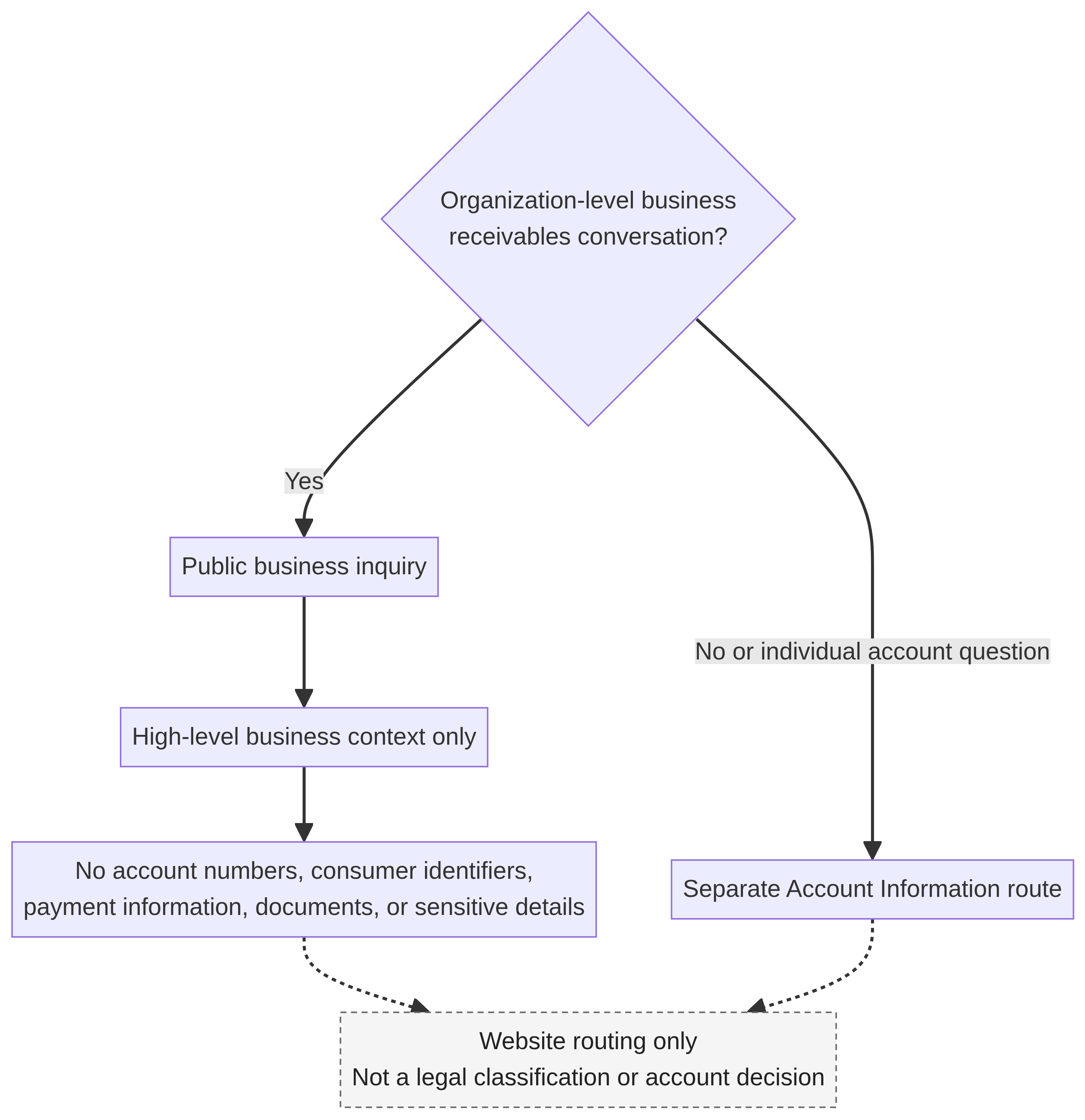
Website routing only — not a legal classification or account decision.
Questions that make a workflow conversation clearer
A business owner can ask focused, vendor-neutral questions without assuming a preferred answer. Who owns the business relationship? Which records should be summarized before the discussion? How will open questions be labeled? What status categories and reporting cadence can be discussed? Who reviews exceptions? How will any later information exchange be arranged after the initial conversation?
Public-sector guidance from the Government Finance Officers Association says written invoicing and collection policies can address decision authority, aging analysis, outside services, and related handling questions (GFOA, Receivables and Handling Receipts in the Treasury Office). NACM likewise identifies transparency, communication, and reporting among the considerations in its guidance (NACM, Collections Policy). These sources are not private-business requirements. They support asking how the work will be understood and reviewed.
For an additional business-owner perspective, the U.S. Chamber’s CO— guide suggests evaluating communication, technology or reporting capabilities, and pricing structure when considering an agency (U.S. Chamber of Commerce CO—, What Is a Debt Collection Agency, and When Do You Need One?). This article does not carry over that guide’s generalized timing or fee discussions. A better conversation focuses on clarity, records, ownership, and reporting rather than a generic claim about results.
Define measurement terms before interpreting them
If a business later discusses measurement, it helps to agree on what each term means before treating it as evidence of performance. PayClear identifies four possible evaluation dimensions: net recovery yield, cost-to-collect, time to first action, and resolution and aging. Those are measurement vocabulary, not customer results, forecasts, or a promise that every data point is available for every portfolio.
For each dimension, the organization and any prospective partner would need to define the baseline, source data, cost treatment, reporting scope, and measurement window. That prevents a label from becoming a misleading comparison. It also keeps the discussion on operational visibility instead of a promised recovery outcome.
A measured next step
If you are an authorized decision-maker with an organization-level commercial receivables question, you may start a conversation through Place Accounts after reviewing the information above. A person reviews business purpose and operating context to identify an appropriate next step; this is not an account-specific decision or an assurance that any placement will be accepted.
The public inquiry is business-level only. Do not include account numbers, consumer identifiers, payment information, documents, or other sensitive details. It is not a payment form, dispute channel, or public file-transfer tool.
Frequently asked questions
Is commercial debt collection the same as business debt recovery?
The phrases can overlap in a business receivables context. This article focuses on the definition and an organized workflow; a separate cash-flow guide may be more useful when the reader wants practical ideas for internal organization. Neither phrase determines the facts, obligations, or next step for a particular account.
What should a business organize before discussing overdue receivables?
At a high level, organize invoice or order context, agreement or payment-terms context, business contacts, payment history, prior communications, and known questions. The goal is to explain the situation coherently, not to put records into a public inquiry. The IRS’s business-record guidance supports keeping invoices and related support orderly (IRS, What kind of records should I keep).
When might an organization evaluate outside support?
It is a workflow evaluation, not a universal deadline. Capacity, documentation readiness, relationship considerations, unresolved issues, and reporting needs can all shape whether an organization continues internally or explores a separate conversation. No recovery result, timing, fee, or placement outcome follows automatically from that choice.
Can I submit individual account details through the PayClear business inquiry?
No. The public business inquiry is for organization-level commercial context only. Do not submit account numbers, consumer identifiers, payment information, documents, payments, disputes, complaints, or other sensitive details. Use the appropriate separate support path for an individual account question.
For continued educational reading, explore more receivables briefings. They can help a business frame its next internal discussion without replacing account-specific, legal, tax, or other professional guidance.
Sources
- F4. Internal Revenue Service, Recordkeeping (last reviewed May 1, 2026; retrieved October 4, 2026).
- F5. Internal Revenue Service, What kind of records should I keep (last reviewed August 3, 2026; retrieved October 4, 2026).
- F7. U.S. Department of the Treasury, Bureau of the Fiscal Service, Appendix 6: Documentation of Collection Activities (retrieved October 4, 2026).
- F8. U.S. General Services Administration, Accounts Receivable and Debt Collection Policy Manual (CFO 4253.1C CHGE 1) (posted August 21, 2020; retrieved October 4, 2026).
- F9. Government Finance Officers Association, Receivables and Handling Receipts in the Treasury Office (board approved September 28, 2018; retrieved October 4, 2026).
- F10. National Association of Credit Management, Collections Policy (retrieved October 4, 2026).
- F12. U.S. Chamber of Commerce CO—, What Is a Debt Collection Agency, and When Do You Need One? (published August 11, 2026; retrieved October 4, 2026).