Category: Commercial operations · Topic: Commercial receivables documentation readiness · ·
Commercial Receivables Documentation: A Readiness Guide Before Escalation
Organize commercial receivables records, open questions, and ownership before an internal review or business-level conversation.
Short answer
Commercial collections documentation is most useful when it gives an internal team one readable view of what it knows: the business relationship and terms context, the invoice record, the relevant performance or service context, open questions, and the person responsible for the next internal review. The goal is not to make a file look complete.
Commercial collections documentation is most useful when it gives an internal team one readable view of what it knows: the business relationship and terms context, the invoice record, the relevant performance or service context, open questions, and the person responsible for the next internal review. The goal is not to make a file look complete. The goal is to make gaps and ownership visible before the team considers its next operating step.
A well-organized readiness file does not decide whether an invoice is valid, whether a balance should be pursued, or what any outside party will do. It is an internal working view. Keep it factual, use the record types that fit the organization’s own workflow, and retain uncertainty when a point has not been confirmed. For related operating context, visit PayClear’s Commercial Operations hub.
Key Takeaways
- Start with one internal view that links business terms, the invoice or statement, operational context, open questions, and an internal owner.
- Treat a missing source as a retrieval task and an open business exception as a separate item; neither should be filled in by assumption.
- A checklist can improve handoffs, but it is not a legally complete file or a determination about any receivable.
- Keep detailed records inside approved internal channels. A public B2B inquiry is for high-level organization context, not account-level or sensitive information.
- A business-level discussion may be useful after the team can describe its general receivables workflow, not because any single file appears “ready.”

Caption: This original editorial illustration represents record organization and internal review. It makes no claim about a particular account or outcome.
What a commercial readiness file should—and should not—do
A readiness file is a navigation tool for the people who work with a commercial receivable. It helps AR, finance, operations, sales, credit, or leadership identify the relevant references without rebuilding the entire transaction history in an email thread. A view can point to the source location, identify the current question, and show who is expected to check it next.
The IRS’s Recordkeeping guidance says a business may choose a recordkeeping system suited to its needs and that purchases, sales, payroll, and other transactions generate supporting documents for its books (S1). That is a useful organizing principle: use a system the team can navigate and make underlying sources findable. It is tax recordkeeping guidance, not a rule for a commercial receivables file or a conclusion about a specific transaction.
The file should also preserve what is unknown. If the business has an invoice copy but has not located a related service-completion record, say so. If an internal note refers to a question that no one has confirmed, label it as open. Clear uncertainty is more useful than a polished summary that silently assumes facts.
This guide is deliberately limited. It does not prescribe contract terms, legal rights, collection tactics, payment arrangements, or an escalation schedule. Its checklist is an operating aid, not a legally complete list and not proof that a file is sufficient for any purpose.
Build one view around five business contexts
A short shared worksheet, internal workspace entry, or folder index can connect the right references. The categories below are examples, not mandatory documents.
- Business agreement context. Record the business entity name used internally, the relevant order, statement of work, service description, purchase reference, or terms reference where one exists. Note the internal source location and the person or function most familiar with the relationship. Do not state that a missing reference exists or infer its terms.
- Invoice and statement context. Include the invoice or internal reference, issue date, due-date field as shown in the internal system, current statement context if used, recorded credits or payments, and a link or path to the source. A current record should identify the version being reviewed rather than paste several conflicting copies into one document.
- Performance, delivery, or service context. Note the operational reference that helps a reviewer locate what happened: a completion record, shipment reference, receiving record, project milestone, service ticket, or another source the business actually uses. The right evidence varies by workflow. A reference should describe where to look, not decide what the record proves.
- Exception or dispute context. Separate an identified issue from a missing document. Capture a neutral description, the date it entered the internal record, the source associated with it, and the person expected to review it. Avoid writing conclusions into the label.
- Internal communication notes. Keep a compact chronology: date, internal owner, business contact role or team, topic, source shared through an approved channel, and next internal check-in. A chronology should help later reviewers understand the sequence without becoming a transcript or a substitute for the source materials.
The National Association of Credit Management describes a commercial credit policy as addressing areas such as monitoring accounts, collections, dispute or deduction handling, communication, and management reporting (S2). That supports assigning clear operating categories and owners. It does not require an organization to adopt NACM’s sample timing, stages, or external-escalation examples.
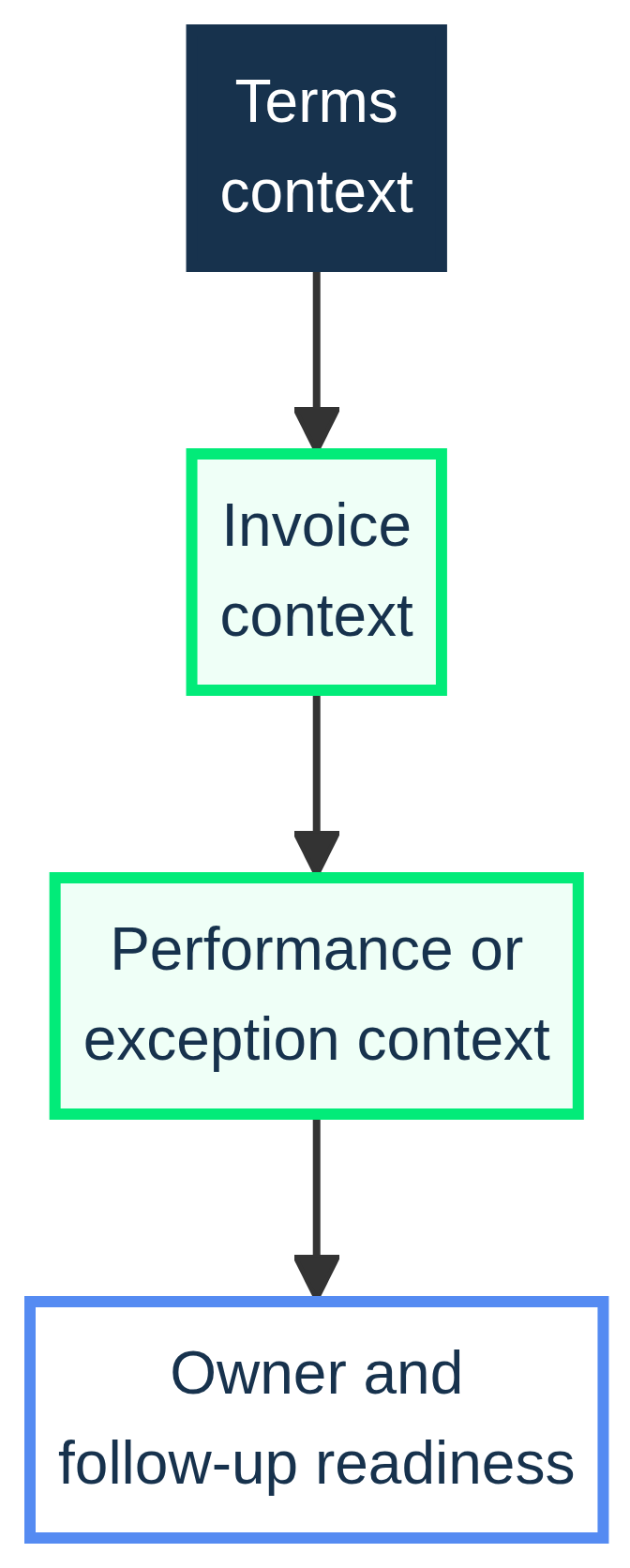
Caption: This editorial map shows a compact internal orientation sequence. It does not determine what a record proves or prescribe an escalation path.
Match performance records to the workflow, not to a generic template
Performance context is often where a file becomes either useful or confusing. A services business may need a project reference or completion note. A distributor may need a shipment or receiving reference. A recurring-services team may use a service period, usage record, or approval context. Put the available reference next to the invoice context so a reviewer can see the connection, then state plainly when a source still needs to be located.
Industry records are not interchangeable. For example, the International Trade Administration explains that a commercial invoice is a document used in export and import clearance and may include transaction information such as an HS code (S3). That is an international-trade example, not a domestic invoice checklist or compliance instruction. Teams with export documentation should retain that context rather than treating every invoice as the same kind of record.
Freight provides another narrow example. The National Motor Freight Traffic Association distinguishes a bill of lading, which concerns goods in transit, from a freight invoice, which focuses on transportation charges and payment (S4). A shipping workflow may need both references to orient an internal review, while a non-freight workflow may not use either. The lesson is not to add logistics paperwork to every file; it is to name the record that matches the underlying business activity.
Use descriptions such as available, needs location, needs internal check, or not used in this workflow. These labels show the status of the internal review without converting a source document into a conclusion about performance, obligation, or resolution.
Separate missing records from open business exceptions
A missing source and an open exception call for different internal actions. If a team cannot locate an invoice copy, order reference, service note, or prior communication, it has a retrieval task. State what is missing, which system or team may hold it, and who will check. The work is to locate or confirm the record, not to fill the gap with a guessed explanation.
An exception is an identified business question that needs review. It may involve a routing issue, quantity question, service concern, timing difference, credit question, or another matter the organization recognizes in its own process. The readiness file should record the question in neutral language, point to the relevant sources, name the internal reviewer, and show a next internal check-in. It should not characterize the issue as resolved because it has been logged.
A simple question log prevents the file from turning into a narrative with no next action. One line can include: confirmed record, open question, internal owner, and next review. If the team later learns more, update the line with the new source or status. This article does not set retention rules.

Caption: This editorial model keeps a confirmed record, an open question, and the next internal review distinct. It is not a legal or escalation workflow.
Assign one owner and make the next review visible
For a workload-focused complement, see the small business debt recovery guide, which covers portfolio prioritization and internal capacity rather than record detail.
Documentation becomes useful when a person or function owns the next internal move. That owner does not need to know every operational detail. Their job is to maintain the working view, ask the right internal question, record the status, and bring in the person who holds a needed fact.
Assign by knowledge rather than by title alone. AR may maintain invoice and payment-entry context; operations may know delivery or completion records; sales or account management may recognize relationship context; a credit or finance lead may review the organization’s internal terms and approvals. Naming the owner for each open point reduces duplicate work and gives leadership a readable way to see what is waiting.
Set a next review point that matches the business’s own operating rhythm. Avoid a universal countdown or escalation clock. A review can be triggered by a newly located record, an internal response, a changed exception, or the organization’s normal portfolio review. The point is visibility, not a prescribed schedule.
Before a handoff, test the file with four questions:
- Can a reviewer identify the invoice or internal reference and the related business context?
- Can the reviewer find the source records or see what is still missing?
- Is each open question distinguished from a confirmed record and assigned to an internal owner?
- Does the file show the next internal review without assuming the result?
If the answer to any question is no, improve the organization of the record first. That does not prevent later discussion; it simply makes the team’s description more accurate.
For a high-level view of how business portfolio context can be discussed after that internal work, see PayClear’s portfolio process overview. That page describes an initial commercial conversation; it does not replace a team’s own operating records or decide what should happen with a particular receivable.
Keep the public inquiry at organization level
Internal documentation and a public inquiry serve different purposes. The internal file can contain controlled business records under the organization’s own procedures. A public inquiry should be much narrower: high-level organization context for a potential B2B receivables-workflow conversation.
Do not put account-level details, consumer information, payment information, documents, personal data, detailed communications, or sensitive information into a public form. Do not use a public inquiry to submit an invoice packet, describe a particular account, request account information, lodge a dispute, or seek a decision about an individual matter. Keep detailed materials outside the public form unless a separately agreed, appropriate process is established after human review.
This distinction also separates consumer support. This guide is not for personal, family, or household debt, and it is not a consumer account-support path. People seeking account information, a dispute process, a communication preference, or another consumer account question should use the separate Account Information route rather than a commercial portfolio inquiry. The commercial public boundary exists to keep business-level context from becoming an account-level exchange.
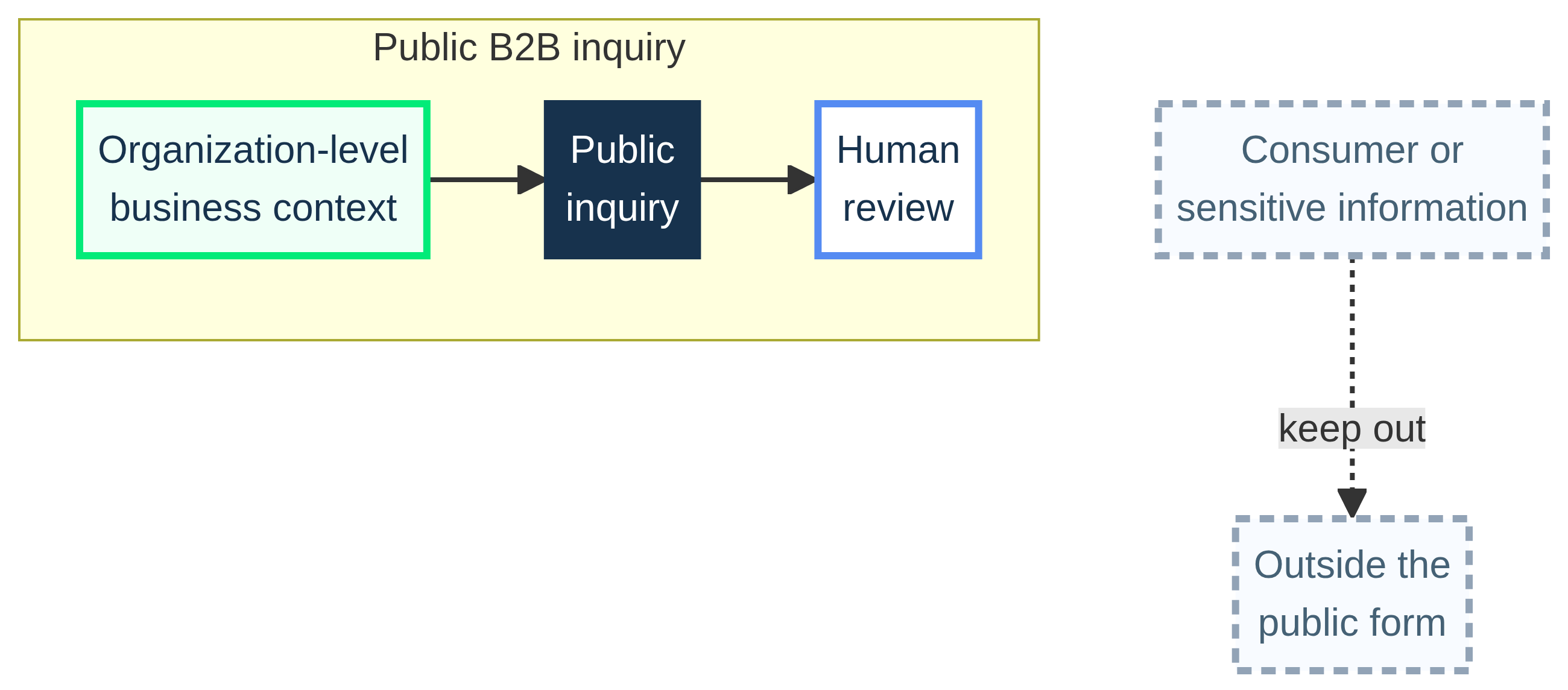
Caption: The public path is for high-level B2B context, not sensitive records, consumer questions, or a document exchange.
After the internal review: a business-level conversation
When the organization can explain its receivables pattern at a high level—its business purpose, general portfolio context, workflow question, and the internal work already completed—it may be ready to request a business-level conversation. That conversation is not an account placement decision, a coverage representation, or a forecast of what will happen next.
If that high-level discussion is useful, start a business-level commercial receivables conversation after the team has organized its records and preserved the public inquiry boundary. Submit only organization-level, non-sensitive B2B context through the public path. The right next step, information-sharing process, and scope of any later discussion remain subject to human review.
Teams that need broader context on business receivables before that conversation can also use PayClear’s B2B receivables guide. The guide addresses general commercial context; this article remains focused on the organization of an internal documentation view.
Frequently asked questions
What belongs in commercial collections documentation before an internal escalation discussion?
Start with the business relationship or terms context, invoice or statement reference, available performance or delivery/service context, open exception or question, internal communication notes, and a named owner for the next review. These are practical categories, not a complete legal checklist or a determination about a specific receivable.
If the team’s main question is broader cash-flow recovery rather than record organization, the business debt recovery briefing is the more appropriate supporting article.
Is a missing record the same as a dispute or other business exception?
No. A missing record is a locating task: identify the source that may contain it and the internal person or system to check. An exception is an identified business question that needs neutral description, relevant sources, an internal reviewer, and a next review point. Keep the two statuses separate so the file stays accurate.
Do freight or export documents belong in every commercial readiness file?
No. The record types should match the transaction. A bill of lading and freight invoice may be relevant to a freight workflow, while export-related commercial-invoice context may matter to an international shipment. Other commercial workflows may use different sources. Add the reference that helps the team understand the actual business activity.
What can an organization put in the public B2B inquiry?
Use only high-level organization-level, non-sensitive business context for a general commercial receivables-workflow conversation. Do not enter account-level information, consumer data, payment information, documents, detailed account narratives, or other sensitive material in the public form.
Sources and editorial scope
- S1. Internal Revenue Service, Recordkeeping (page last reviewed or updated 2026-05-01; retrieved 2026-10-04). Used for business-record organization only.
- S2. National Association of Credit Management, Collections Policy (retrieved 2026-10-04). Used for examples of commercial-policy subject areas only; its sample escalation schedule is not adopted here.
- S3. International Trade Administration, Commercial Invoice (retrieved 2026-10-04). Used only as an international-trade documentation example, not as compliance guidance or a domestic checklist.
- S4. National Motor Freight Traffic Association, Bill of Lading vs. Freight Invoices: How They Differ (retrieved 2026-10-04). Used only to distinguish freight record roles in the limited freight example.
Editorial scope disclosure: The Ubersuggest check recorded for the United States/English on 2026-10-04 reported zero current volume for the sole focus keyword. This is therefore a support-intent commercial operations guide, not a traffic forecast, ranking forecast, or new vertical SEO page.