Category: Industry receivables · Topic: Construction receivables readiness · ·
Construction Debt Collection: What Materials Suppliers and Contractors Should Organize Before Escalation
Construction debt collection readiness starts with an organized project record, clear open questions, and a business-level human conversation.
Short answer
Construction debt collection is easier to evaluate when an overdue business-purpose receivable is organized around one project record rather than scattered across email, billing, and field notes. Start by identifying what was billed, what supports the work or delivery, what changed, what is still questioned, and who owns the next internal step.
Construction debt collection is easier to evaluate when an overdue business-purpose receivable is organized around one project record rather than scattered across email, billing, and field notes. Start by identifying what was billed, what supports the work or delivery, what changed, what is still questioned, and who owns the next internal step. That preparation does not decide an outcome. It gives a materials supplier, contractor, rental provider, or subcontractor a workable basis for a measured business conversation.
This guide concerns B2B business-purpose receivables only. Project, contract, and payment requirements vary. It is not legal, contract, or account-specific advice. For broader workflow context, see PayClear's B2B receivables guide.
Key Takeaways - Build one project record that connects the relationship, billing basis, delivery or work context, changes, open questions, and communication history. - Treat a missing record and an unresolved commercial question as different items, with a clear owner for each. - Keep a public inquiry high level. Detailed project and account materials belong outside a public website form. - A business-level conversation is most useful after the team can describe its workflow context without sharing sensitive account details publicly.

Caption: This editorial diagram is an illustrative operating model, not legal or contract advice.
Construction debt collection starts with a project record, not a pile of messages
A project record lets an internal team understand an overdue balance before deciding on its next conversation. Scope, billing, deliveries or completed work, changes, and business contacts may sit in different systems. A single working view can show whether the immediate need is documentation, a question, or an owner.
It is not a universal file or an interpretation of an agreement. It preserves the facts the business already has. The IRS says a business should keep a recordkeeping system suited to its needs and notes that transactions create supporting documents (IRS, Recordkeeping). The practical question is whether the team can locate the records it relies on for this project.
Clear source records and an accounting trail are documentation concepts in the Washington State Department of Transportation's construction manual (WSDOT, Construction Manual, Chapter 10). The public-works manual is not a private-project rulebook. Its operational lesson is to label each source and show how records connect.
A project view also keeps the relationship context visible. The goal is a concise internal picture, not a replacement for the organization's own systems or judgment.
Editorial synthesis: Project record completeness is an operating question before it is an escalation question.
Build a project record that makes the next review easier
A useful record makes the balance and unknowns clear to AR and operational contacts. A spreadsheet, project workspace, or internal checklist can work when it reliably points people to source materials.
Start with a short project identity section: the business customer, project name or internal reference, your organization's role, and the internal people who can answer operational or billing questions. Then note the billing basis and the project's current internal status. The aim is orientation, not an interpretation of any agreement.
Next, create a record index. Common items may include a reference to the governing business arrangement, billing or payment-application context, a work breakdown or schedule reference where one exists, delivery or receipt context, change history, and prior communication notes. Procore describes change orders as records of adjustments to scope, cost, and schedule, and identifies project/contact data, dates, work details, schedule effects, cost, and updated value as common elements (Procore, How Change Orders Work in Construction). What is required or useful will differ by project and agreement.
Payment applications can also draw on a request summary, work breakdown, invoices or receipts, delivery confirmations, and photos, among other supporting materials (NetSuite, The Ultimate Guide to Construction Payments). That vendor guide does not establish a mandatory checklist. It does, however, illustrate why a reviewer should know which supporting record is present and which needs internal follow-up.
Keep an aging context in plain language: what the team believes remains open, what communications have occurred, and what needs confirmation. Do not convert a partial record into a conclusion. A concise index can be more useful than a large folder with no evident sequence.
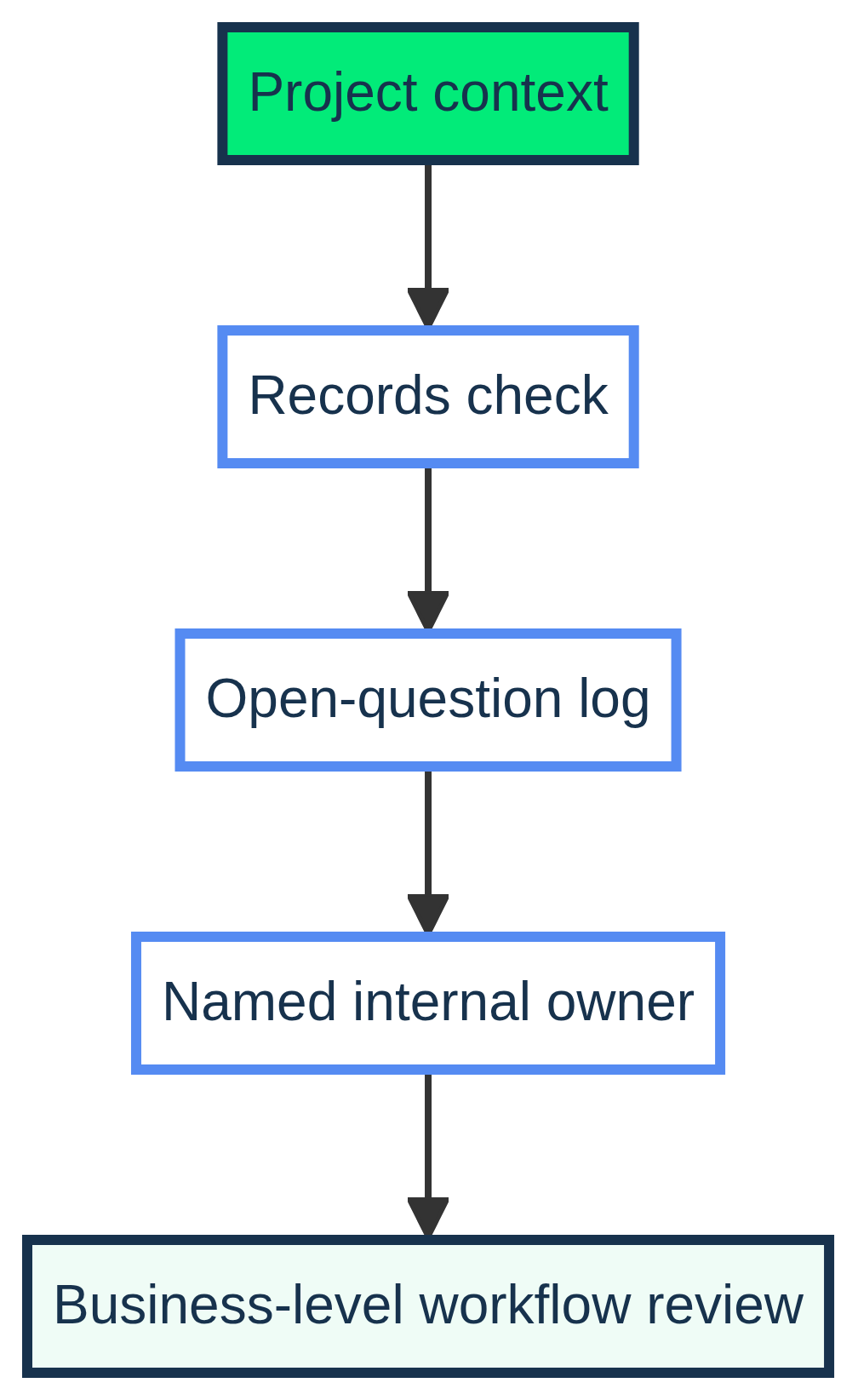
Caption: This diagram is an illustrative operating model, not legal or contract advice.
Separate a missing record from an unresolved commercial question
Do not treat every open item as the same problem. A missing delivery confirmation, change record, or communication note is a document-retrieval task. A question about the project, billing, or prior discussion needs a plainly stated owner and follow-up.
Use an open-question log with two columns before adding more detail: what is missing or unclear and who will address it. Include the date the item was logged and the next planned check-in. This avoids burying unresolved points in narrative notes. It also stops a team from treating a document label as proof that the underlying question is settled.
NACM's collections-policy guidance describes consistent processes, documented communications, discrepancy resolution, and defined escalation roles as common commercial credit practices (NACM, Collections Policy). It is industry association guidance, not a timetable or rule for every business. The practical takeaway is modest: define a repeatable internal way to record what happened and what happens next.
For example, an AR team could record “delivery record needs location” separately from “project contact's question needs operational response.” The wording should stay factual. A reviewer can then see which task is administrative, which needs project knowledge, and whether the record changed after the next communication.
Give the record a named owner and a repeatable update habit
An organized file still stalls if no one maintains it. Assign a primary owner and a project-side contributor for operational context. Roles vary by organization, but each person should know what to update and when the team will recheck the open-question log.
After every material communication, add a brief entry: date, internal participant, business contact role, subject discussed, and the agreed or planned next internal action. Avoid vague notes such as “followed up.” A future reviewer should be able to understand the sequence without reconstructing it from several inboxes.
This habit supports consistency without imposing a fixed cadence. NACM emphasizes documenting communications and defining escalation roles in a collections process (NACM, Collections Policy). Your own workflow can use that idea while remaining suited to your customer relationships and project practices. PayClear's business debt recovery guide offers related reading on keeping actions visible within a business receivables process.
A named owner also makes handoffs cleaner. If a controller needs a project manager's input, the record should identify the precise question, the source being checked, and the expected internal response. That is more actionable than forwarding a general request with no project context.
Keep public inquiries high level and protect the information boundary
A public website inquiry is for a high-level business conversation, not detailed project-file exchange. Prepare only an organization-level description: your organization type, the general portfolio pattern, and the conversation you want to have. A human reviewer can then determine whether a conversation is appropriate.
Do not upload, paste, or submit consumer, personally guaranteed, mixed-use, account-level, payment, dispute, complaint, document, customer/account-holder contact, or sensitive personal information into a public web form. Keep detailed invoices, payment applications, project records, agreements, and account materials within your internal process unless and until a later exchange is separately agreed. PayClear's current business inquiry boundary uses organization-level business context such as the legal business name, role or authority, work email, company size, balance range, and non-sensitive portfolio context. It is not a request to submit a project file or a decision about a specific balance.
This boundary helps the initial discussion stay proportional to its purpose. It also means the first message can focus on the operating context: whether the organization is dealing with a group of business receivables, whether project records are being organized, and whether a business-level workflow conversation would be useful. For a related perspective on a controlled customer-facing workflow, see first-party receivables support.
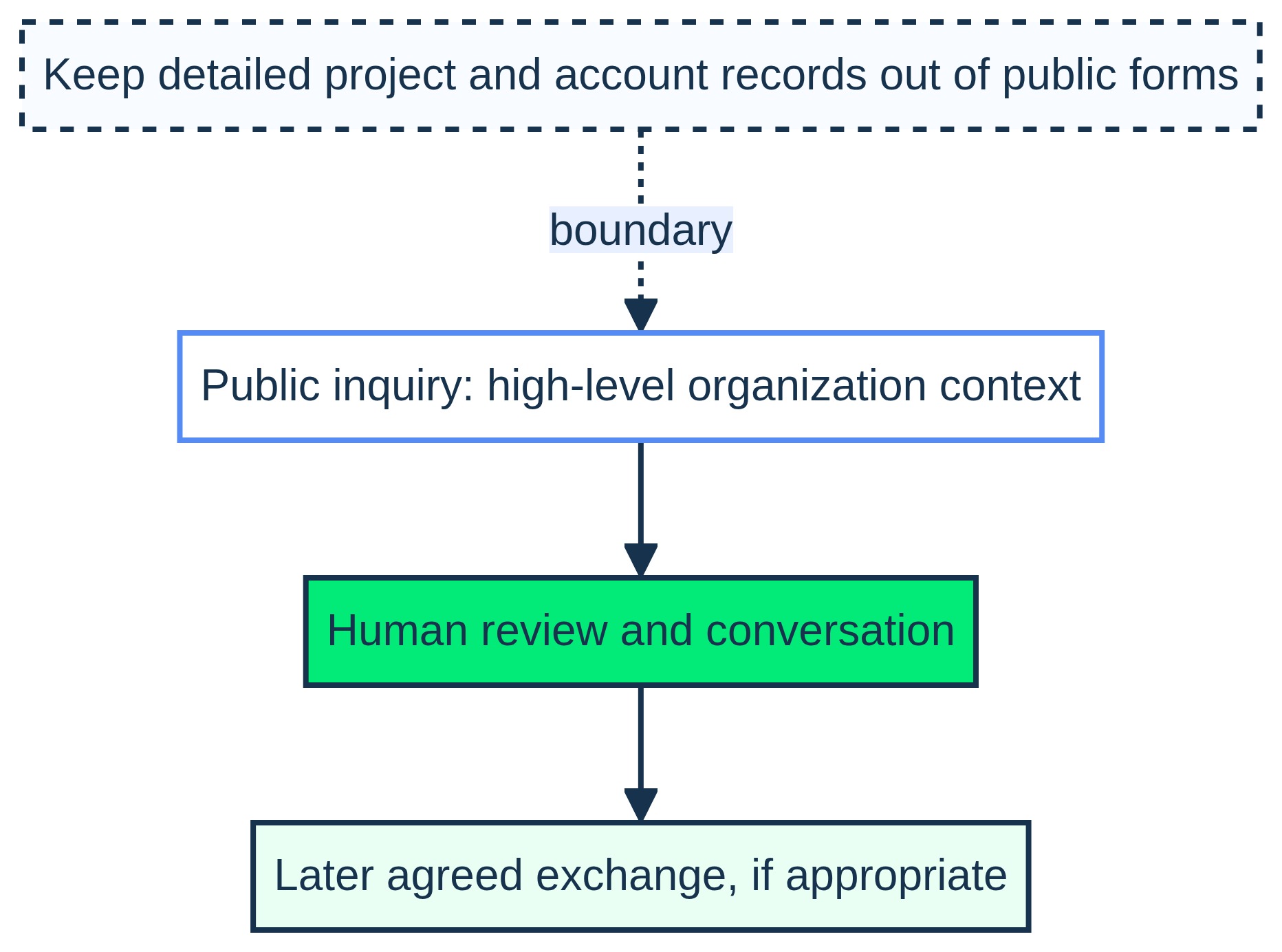
Caption: This diagram is an illustrative operating model, not legal or contract advice.
When a business-level workflow conversation is useful
A business-level workflow conversation can be useful once your team can describe the operating picture without turning a public form into a document repository. You may be ready if you can describe the type of business-purpose receivables, the general pattern, the fact that records are being organized, and the process questions your team wants to discuss.
That conversation is not a determination about any specific balance. It is an opportunity for human review of high-level commercial context. Keep the request concise and do not add detailed project or account materials to a public form. If a more detailed exchange is appropriate later, its process should be agreed separately rather than assumed from the initial inquiry.
For businesses that are considering how routine work can be organized with human review, PayClear's article on technology-assisted collection workflows provides additional context. The central principle remains the same: preparation should make the next conversation clearer, not make a public channel carry information it was not designed to receive.
Ready to discuss your workflow at a business level? Visit Place Accounts to request a business-level commercial portfolio conversation. Please use the page only for high-level context; it is not a public document upload or account-detail submission route.
Use this readiness checklist before any internal escalation conversation
A short checklist makes it easier to decide what needs work before the next internal review. It is an operating aid, not a universal project requirement.
- [ ] The team can identify the project and its internal reference without searching across multiple unrelated threads.
- [ ] The record names the customer business relationship and the internal people responsible for AR and project context.
- [ ] The billing basis and current open amount are described internally in plain language.
- [ ] The file index identifies available billing, work, delivery or receipt, and change-history context.
- [ ] Missing records are listed separately from unresolved commercial questions.
- [ ] Each open item has an owner, a next action, and a planned internal check-in.
- [ ] Material communications are logged with a date, role, subject, and next action.
- [ ] Any public inquiry is limited to high-level organization context, with consumer, personally guaranteed, mixed-use, account-level, payment, dispute, complaint, document, customer/account-holder contact, and sensitive personal information kept out of the form.
When the checklist exposes gaps, do not paper over them with a generic status. Assign the gap, update the log, and return to the project record. The decision diagram below shows the basic sorting logic: find the open type, assign the next internal task, then update the record before deciding whether a business-level review is timely.
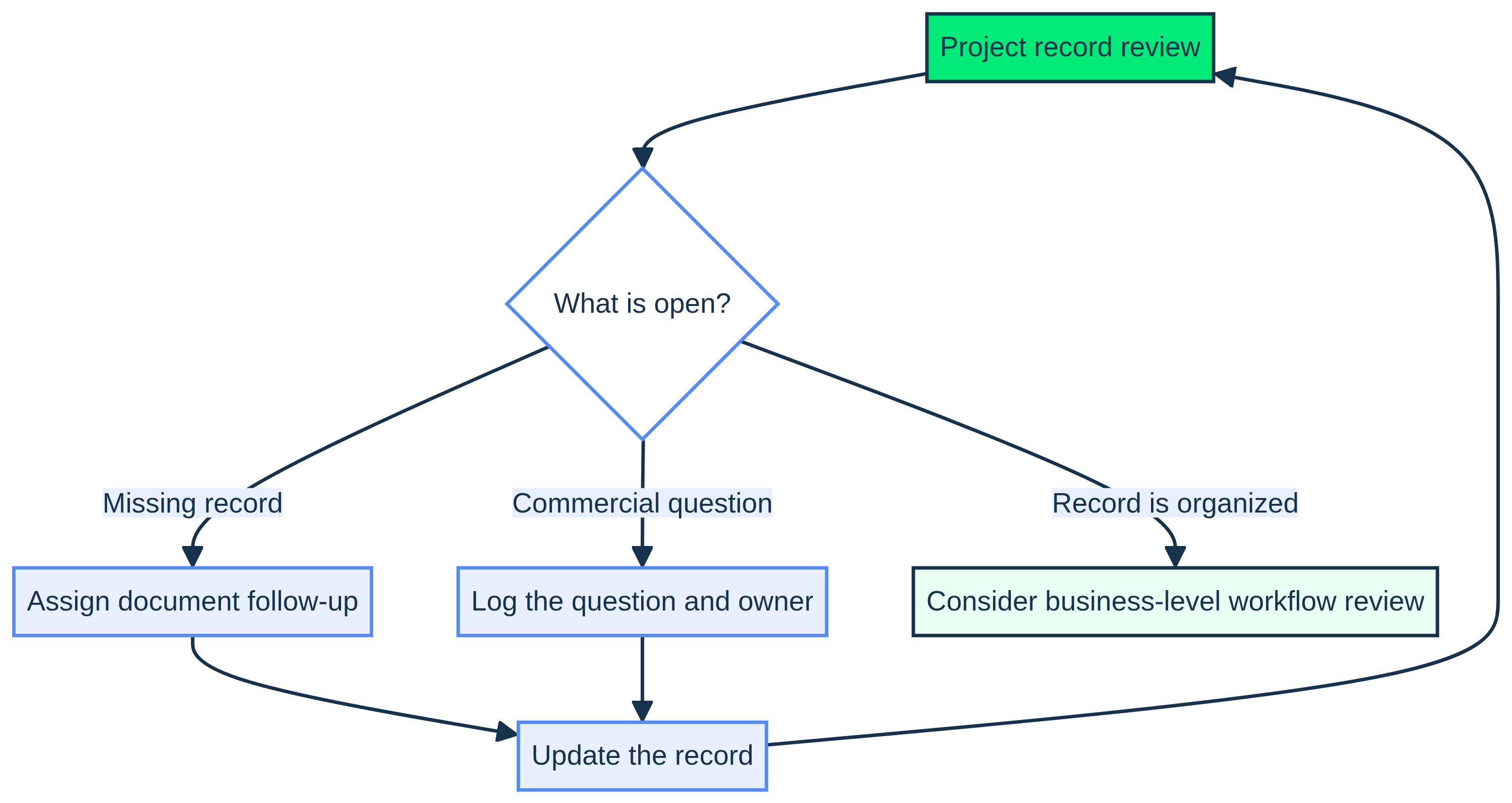
Caption: This diagram is an illustrative operating model, not legal or contract advice.
Frequently asked questions
What belongs in a construction receivables project record?
Keep the record focused on internal review: project identity, relationship context, billing basis, available work or delivery support, change history, communication notes, open questions, and named owners. The useful contents vary by project and agreement. IRS recordkeeping guidance supports using a system suited to the business and retaining the supporting documents created by transactions (IRS, Recordkeeping).
Is a missing document the same as a disputed project issue?
No. A missing document is an information-retrieval task. An unresolved commercial question needs a factual description, an owner, and a follow-up. Keeping those categories separate helps the team see what it can locate internally and what requires a business conversation.
What should be included in a public inquiry?
Use only high-level organization and workflow context for B2B business-purpose receivables. The current inquiry uses organization-level business information, not project-file transfer. Do not include consumer, personally guaranteed, mixed-use, account-level, payment, dispute, complaint, document, customer/account-holder contact, or sensitive personal information. The initial purpose is human review of general commercial context, not a detailed file transfer.
Who should own the next internal action?
Choose a primary owner for the project record and involve an operational contributor when project knowledge is needed. NACM's guidance identifies documented communications, discrepancy resolution, and defined roles as elements of a consistent commercial credit process (NACM, Collections Policy). The right role assignment depends on your organization.
Organize first so the next conversation can be specific
A clear project record does not answer every question about an overdue construction receivable. It does give the business a dependable place to see what was billed, what information supports the project context, what changed, what remains open, and who is accountable for the next internal action.
Keep the work practical: combine related facts, label gaps, log material communications, and keep public inquiries at the organization level. If your organization wants to discuss its commercial portfolio workflow after that preparation, the current Place Accounts route is available for a business-level conversation. Project, contract, and payment requirements vary, and this article is not legal, contract, or account-specific advice.
Sources and notes
- IRS, Recordkeeping: Supports general business recordkeeping concepts and supporting-document context. Limitation: tax recordkeeping guidance, not construction-payment or contract advice.
- WSDOT, Construction Manual, Chapter 10: Documentation: Supports the value of accurate, complete source records and an accounting trail. Limitation: public-works agency manual, not a private-project standard or legal requirement.
- Procore, How Change Orders Work in Construction: Supports the examples of common change-record elements. Limitation: vendor educational material; project and contract processes vary.
- NetSuite, The Ultimate Guide to Construction Payments: Supports examples of supporting materials that may accompany payment applications. Limitation: vendor educational material; components vary by project and agreement.
- NACM, Collections Policy: Supports the discussion of consistent processes, communication records, discrepancy resolution, and roles. Limitation: industry association guidance, not a mandated timetable or PayClear policy.
- PayClear Place Accounts: Supports the current organization-level, business-purpose public inquiry boundary. Limitation: describes the current public intake boundary only; it is not a detailed file-exchange process or a decision about any account.