Category: Industry receivables · Topic: Manufacturing and wholesale trade-credit readiness · ·
Manufacturing Receivables: A Documentation and Trade-Credit Readiness Guide
Organize manufacturing receivables around order-to-invoice records, open exceptions, internal ownership, and high-level workflow context.
Short answer
Manufacturing debt collection readiness starts with an organized business record, not a larger stack of messages. When a B2B trade-credit invoice is past due, the useful first step is to connect the order reference, fulfillment context, shipment or receiving context, invoice, and any open question in one high-level view.
Manufacturing debt collection readiness starts with an organized business record, not a larger stack of messages. When a B2B trade-credit invoice is past due, the useful first step is to connect the order reference, fulfillment context, shipment or receiving context, invoice, and any open question in one high-level view. That view helps operations, credit, AR, and sales describe what they know, what they still need to locate, and who can review an exception. It does not settle a commercial question or replace the organization’s own judgment.
This guide is limited to business-purpose manufacturing, wholesale, and distribution receivables. It offers an operating model for preparing a clearer internal conversation, rather than guidance for a particular account. For broader context on organizing B2B receivables work, see PayClear’s B2B receivables guide.
Key Takeaways
- Connect the order reference, fulfillment context, shipment or receiving context, invoice, and open exception in one internal record.
- Treat a missing record as a retrieval task and a commercial exception as a separate item with a named internal reviewer.
- Keep an exception log short, factual, and readable across operations, credit, AR, and sales.
- A public inquiry should contain only organization-level business context, never detailed account materials or sensitive information.

Caption: This editorial illustration is an illustrative operating model, not legal, contract, or account advice.
Manufacturing debt collection readiness begins with one connected record
A connected record gives a team a common starting point before it decides what to discuss internally. In manufacturing and wholesale settings, the relevant context can be spread across an order system, production notes, warehouse records, shipping records, billing tools, and email. The goal is not to force every business into the same file structure. It is to make the sequence readable enough that a reviewer can see the relationship among the materials already held by the business.
The IRS recordkeeping guidance explains that a business may use a recordkeeping system suited to its needs and that purchases and sales generate supporting documents for its records. Applied here, that is a modest documentation principle: use a system the team can navigate, and make source records findable. It does not turn a document into proof of performance, payment obligation, ownership, or any particular next step.
For a manufacturer, the first view can be a spreadsheet row, a workspace entry, or an internal dashboard card. What matters is that the view points to existing sources without copying every page into one place. A reviewer should be able to identify the business relationship, the order reference, the invoice reference, the current question, and the person expected to help clarify it.
Editorial synthesis: Record completeness is an operating question before it becomes a conversation about an overdue receivable.
Map the order-to-invoice sequence without treating it as a universal checklist
A practical record often starts with the order reference. That might be a purchase-order number, order number, release number, or another business identifier used consistently by the organization. Add the business customer name used in the internal system, the product family or general order description, and the internal team members who understand the order context.
Next, note the fulfillment context that is available. Depending on the organization’s process, that could be a production release, pick or pack reference, service completion note, warehouse status, or another internal source that describes where the order moved through the business. The point is orientation. Do not assume the same document exists for every product line or transaction pattern.
Then add shipment or receiving context in the terms the business uses. A shipment reference, carrier reference, delivery note, receiving confirmation, or internal fulfillment status may help a reviewer locate the right people and systems. The invoice belongs in the same connected view, along with its reference, date, amount shown in the internal system, and the internal status the team is reviewing. Keep the record descriptive. A label is not a conclusion about what happened.
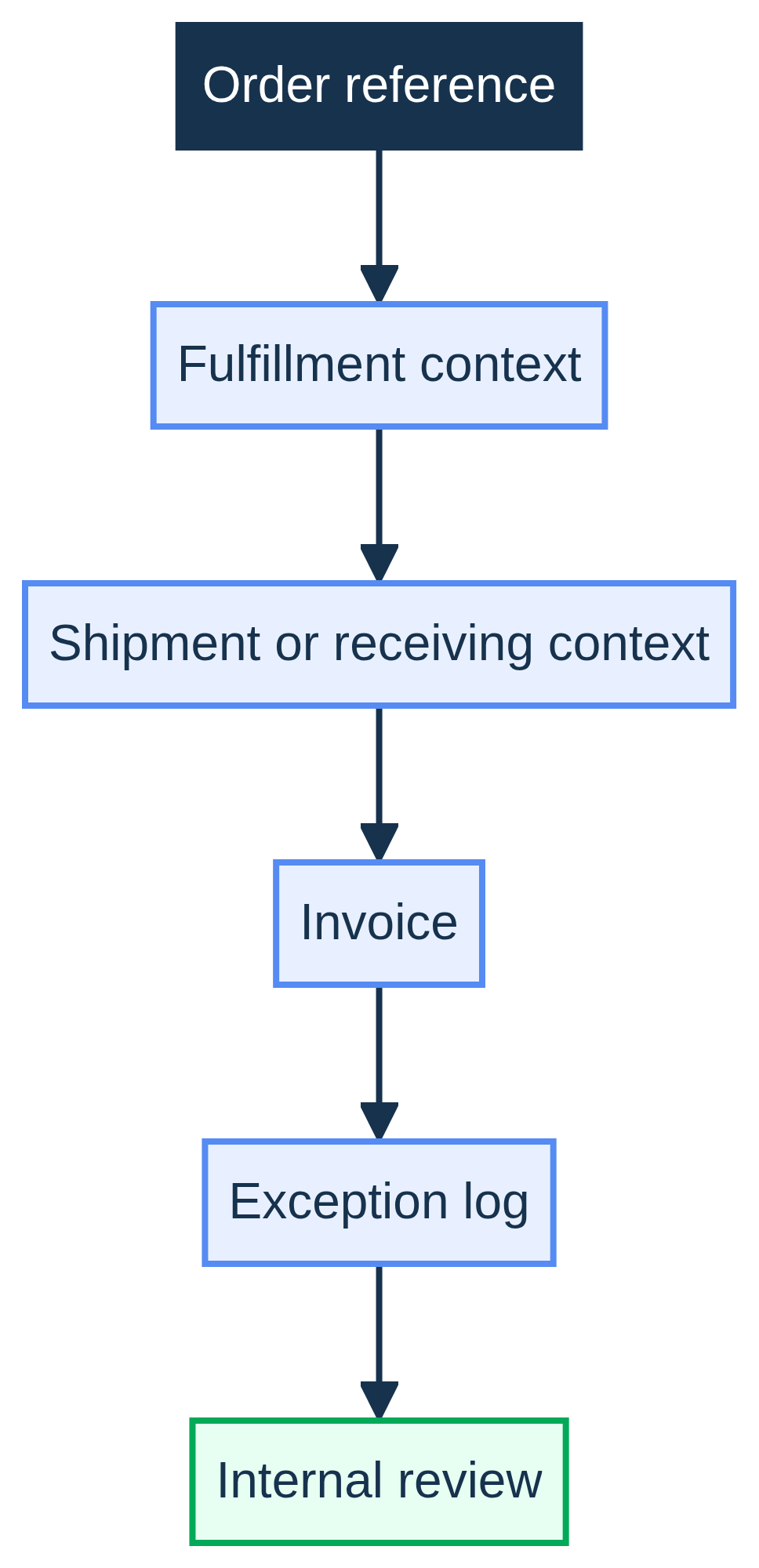
Caption: This diagram is an illustrative operating model, not legal, contract, or account advice.
For teams that need a wider AR process perspective, PayClear’s business debt recovery guide discusses keeping business receivables actions visible. The manufacturing record should remain narrower: it is a way to make the order-to-invoice trail understandable to the people who need to review it.
Keep a source index so internal reviewers can locate context quickly
A record is easier to use when it contains a simple index rather than a long narrative. For each source, note its internal name or reference, where it can be found, the business function that maintains it, and whether it is available for the current review. A short index shows where to begin without turning a working record into a document dump.
Use plain statuses such as “available,” “needs location,” “needs internal check,” or “not used in this order path.” Avoid labels that imply more than the team knows. If an invoice copy is present but a shipment reference has not yet been located, the record can state exactly that. This approach helps a reviewer distinguish an incomplete file from an unresolved business question.
The index can also capture communication chronology at a high level: date, internal participant, business contact role, topic, and planned internal follow-up. It should not contain a detailed transcript or sensitive account material. An abbreviated chronology gives later reviewers a sequence without requiring them to search across several inboxes.
This kind of organization also reduces handoff friction. Operations may know the fulfillment path, AR may know the invoice trail, credit may know the terms used in the business relationship, and sales may know the customer context. A shared index tells each person what question is being asked of them. For a customer-facing workflow perspective, see PayClear’s first-party receivables support article.
Separate missing documentation from a commercial exception
A missing record and a commercial exception need different handling. If the team cannot find an invoice copy, shipment reference, receiving note, or internal communication, the next task is information retrieval. State what is missing, where the team has looked, and which internal function is best placed to locate it.
A claimed short shipment, quality question, price difference, credit memo question, or delivery question is different. It is an open commercial item that needs a named internal reviewer. The record should describe the issue in neutral terms, identify the relevant source material, and show the next internal check-in. It should not treat a source label as a resolution.
The National Association of Credit Management’s collections-policy guidance identifies areas such as roles, terms of sale, account monitoring, dispute or deduction handling, communication, and management reporting within a commercial credit policy. That supports a simple operating distinction: record retrieval can be assigned as a locating task, while an exception can be assigned to the function with the knowledge to review it. It does not prescribe a timetable or a decision for a particular receivable.
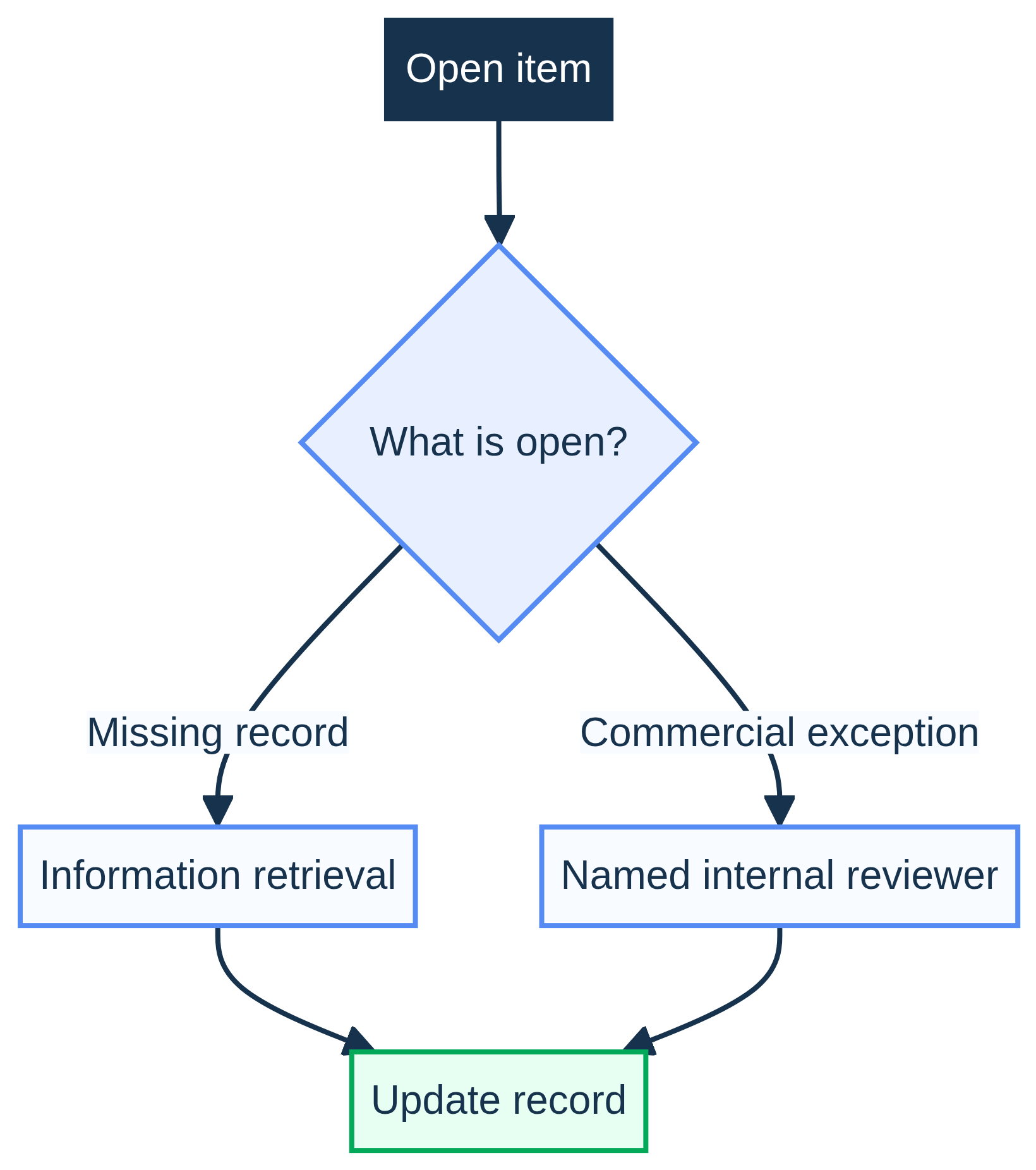
Caption: This diagram is an illustrative operating model, not legal, contract, or account advice.
Use an exception log that operations, credit, AR, and sales can read
An exception log should make open items visible without overstating them. Start with an issue category, a concise factual description, the record available or missing, the named internal owner, the prior communication reference, and the next internal check-in. One row per item is often more readable than a long case narrative.
For example, “shipment record needs location” is a retrieval item. “Customer reports quantity difference; operations review requested” is an exception item. The wording stays factual, shows the owner, and avoids blending a document search with a business question. A future reviewer can see whether the item changed after the next check-in.
Assign ownership by knowledge, not by title alone. A warehouse lead may know the fulfillment context. An AR lead may know how the invoice was issued. A credit lead may understand the trade-credit terms used by the organization. A sales contact may provide relationship background. The log should name the person or function expected to check the specific point, while the team retains responsibility for its own decisions.
A regular internal update habit can keep the log usable. After a material communication, add a compact factual entry and indicate what internal verification remains. This is not a fixed schedule. It is a way to prevent the open item from disappearing into an email thread. PayClear’s AI collection workflows article provides related reading on keeping human review central when technology helps organize work.
Use trade-credit terms as shared context, not a conclusion
Terms, due dates, purchase-order references, invoice references, and delivery or shipment context can help a business frame its own review. Put them in the connected record as shared context, alongside the open exception and the person assigned to review it. The benefit is clarity: a reviewer sees which reference belongs to which part of the order-to-invoice sequence.
Do not use a term, reference number, or invoice description to make the record say more than it can support. The team may need to locate other internal context, clarify a discrepancy, or ask a knowledgeable colleague to review the sequence. A well-organized record preserves that uncertainty instead of concealing it.
Export documents illustrate distinct context, not a domestic checklist
Export-related document guidance is useful only as an example of why document types need to be read in their own context. The International Trade Administration’s commercial-invoice page describes a commercial invoice in an export/import clearance setting and notes that it can include transaction information, including HS codes. The International Trade Administration’s packing-list page describes an export packing list as an itemized account of package contents, weights, measurements, and goods.
Those descriptions concern export shipments. They do not define a domestic manufacturing invoice, domestic packing record, or the records that any particular business should use. For an internal reviewer, the useful lesson is simply to label a source by its role and context, rather than treating every document type as interchangeable.
Keep the public inquiry boundary at organization level
A public inquiry is appropriate only for high-level organization context and a general business-purpose workflow conversation. It is not a place to submit a customer file, paste an invoice history, or upload order-to-invoice materials. A concise inquiry can identify the organization, an authorized business contact’s name, the submitter’s role or authority, a work email, company size, balance range, receivables category, and non-sensitive commercial context.
Do not enter consumer, personally guaranteed, mixed-use, account-level, payment, dispute, complaint, document, customer/account-holder contact, sensitive personal information, or personal/family/household debt in a public form. Keep detailed invoices, order records, shipment materials, communications, and other account materials outside the public inquiry. Any later exchange of detail should happen only through a separately agreed process after human review.
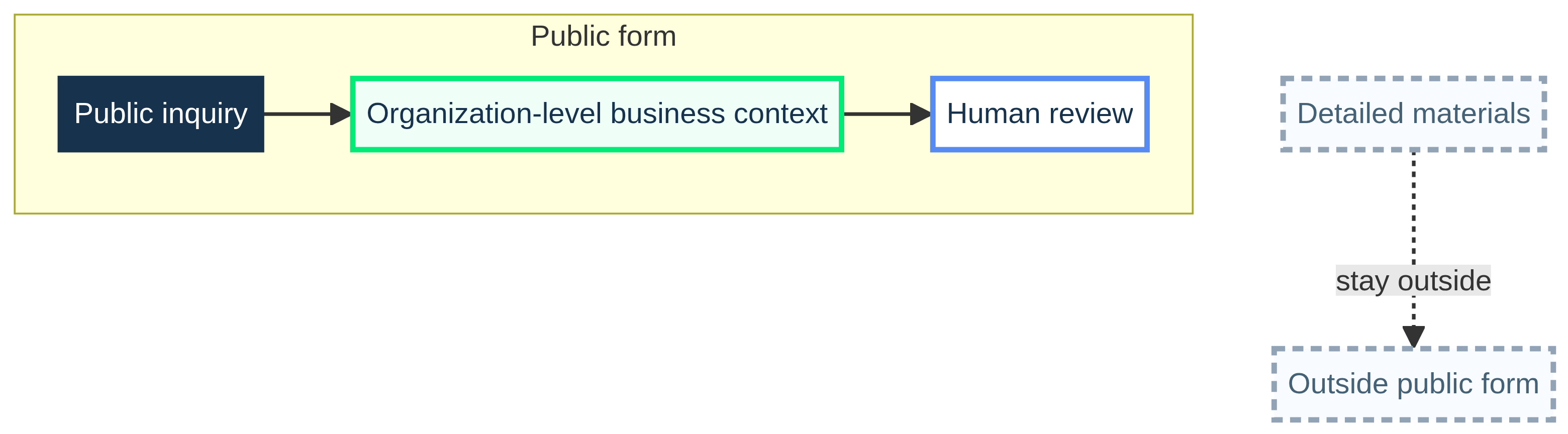
Caption: This diagram is an illustrative operating model, not legal, contract, or account advice.
This boundary keeps the first conversation proportional to its purpose. It also gives the submitting organization a simple preparation task: describe the broader B2B receivables pattern and the business function seeking a conversation, rather than trying to turn the public form into an account workspace.
Frequently asked questions
What records matter for a manufacturing receivables review?
Start with the references that connect the order to the invoice: the business relationship and order reference, available fulfillment context, shipment or receiving context, invoice reference, and any open exception. The best set of records varies by organization and order path. The goal is a findable internal trail, not a universal checklist or a conclusion about a specific receivable.
How is a missing record different from a commercial exception?
A missing record is an information-retrieval item: the team needs to locate a source or confirm whether it exists in the relevant system. A commercial exception is an open business question, such as a reported quantity, quality, price, credit memo, or delivery issue. Keep the two items separate and name the internal person or function reviewing the exception.
Are export documents a checklist for domestic manufacturing transactions?
No. The International Trade Administration pages cited above describe commercial invoices and packing lists in export-related contexts. They are examples of documents carrying specific shipment context, not a domestic checklist. Internal teams should use the record types and terminology that fit their own business process.
What belongs in a public inquiry about a business receivables workflow?
Only organization-level business context belongs in a public inquiry: the organization, an authorized business contact’s name, the submitter’s role or authority, work email, company size, balance range, receivables category, and non-sensitive commercial context. Detailed account materials and the excluded categories listed above stay outside the public form.
When a business-level workflow conversation is useful
Once the team can describe its B2B receivables pattern at a high level, it may be ready to request a business-level portfolio conversation. Keep that request focused on organization-level context, not individual account records or documents. Request a business-level portfolio conversation after the internal record and exception log have clarified the general workflow question.
Sources and limitations
- IRS, Recordkeeping: Used for the general point that a business can use a suitable recordkeeping system and that purchases and sales generate supporting documents. This is federal recordkeeping guidance, not a manufacturing workflow prescription or an account-resolution rule.
- National Association of Credit Management, Collections Policy: Used for examples of policy areas such as roles, terms, monitoring, discrepancy or deduction handling, communication, and reporting. This is industry association educational guidance, not a required process, timetable, or recommendation for a particular receivable.
- International Trade Administration, Commercial Invoice: Used only to describe the export/import context of a commercial invoice and the type of transaction information it may contain. It is export-specific guidance and does not define domestic invoice requirements.
- International Trade Administration, Packing List: Used only to describe an export packing list’s itemized shipment context. It is export-specific guidance and does not establish a universal domestic record requirement.
A connected order-to-invoice record and a separate exception log give a manufacturing, wholesale, or distribution team a clearer internal starting point. Keep the record factual, make ownership visible, and preserve the public inquiry boundary. For additional general background on business receivables work, return to PayClear’s B2B receivables guide.