Category: Industry receivables · Topic: Equipment finance receivables operating model · ·
Equipment Finance Collections: In-House vs. Outsourced Commercial Collections
Compare in-house and outsourced equipment finance collections with PayClear, a Clear Recovery Solutions company: capacity, controls, records, and handoffs.
Short answer
Equipment finance collections can stay in-house when a business has sufficient capacity, authority, record access, and governance. An outsourced commercial collections model may be evaluated when portfolio volume, aging, staffing pressure, exception complexity, or reporting needs make the current approach hard to sustain. The decision should remain a portfolio-level operating-model comparison, not a promise about account outcomes.
Short answer: Keep equipment finance collections in-house when work is routine, the commercial relationship is active, records are complete, and capacity is clear. Consider outsourced commercial collections only for selected accounts needing focused follow-up or a governed escalation path. For many lender and lessor portfolios, a hybrid model works best: internal teams retain early-stage servicing, context, and approval rights; an outside specialist works segments meeting a defined trigger.
This guide is for commercial equipment-finance lenders, lessors, dealer-finance teams, and B2B receivables leaders. It is general business information, not legal or account-specific advice.

An editorial illustration of organization-level equipment-finance workflow context—not a customer account file or a specific collection action.
Quick comparison: in-house vs. outsourced equipment finance collections
| Decision factor | In-house A/R and early-stage servicing | Outsourced commercial collections for selected accounts |
|---|---|---|
| Primary scope | Billing context, routine follow-up, relationship-sensitive conversations, and internal issue routing | Focused commercial outreach and a defined escalation path after an approved trigger |
| Account context and control | Direct access to customer history, portfolio context, and internal approvers | Requires a documented handoff, clear decision rights, and reporting expectations |
| Capacity | Constrained by current staffing, systems, and competing servicing work | Can add specialist operating capacity for a defined portfolio segment |
| Cost structure / pricing | Measure payroll, training, technology, leadership time, and overhead against workload | Confirm the provider’s fee schedule, expense treatment, authority limits, and reporting terms; do not assume a universal contingency rate |
| Documentation readiness | Internal teams can correct billing or record gaps before escalation | A complete, reviewed file is essential; an outside partner cannot solve missing terms or unclear records by itself |
| Equipment-finance complexity | Useful when a team needs to interpret servicing, relationship, or unresolved business context | Useful when a well-defined commercial account needs specialist follow-up while internal owners retain material authority |
| Reporting and governance | Direct access to internal systems and status views | Contractual reporting, data access, communication standards, and exception-return rules should be explicit |
| Best fit | Routine or relationship-sensitive work with clear ownership and capacity | Handoff-ready accounts that exceed internal capacity or need a separate commercial path; often part of a hybrid model |
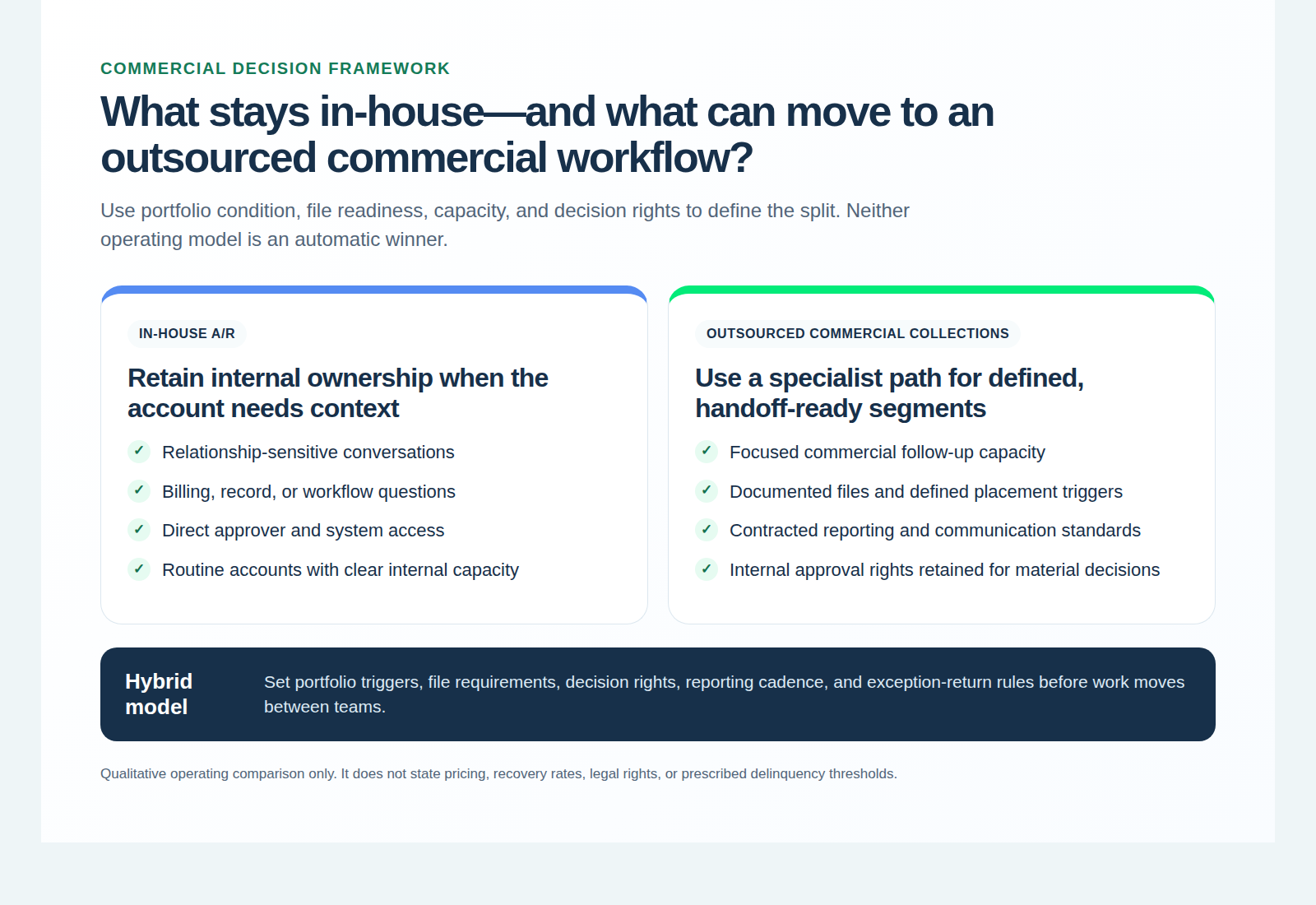
The comparison is qualitative. It does not claim that either model is universally cheaper, faster, or more successful.
What each model covers
In-house A/R retains servicing context and internal authority
In-house collections normally means the creditor’s finance, servicing, credit, or receivables team manages the early work: monitoring the portfolio, checking payment or billing context, following up with the appropriate business contact, and routing open questions to an internal owner. This model is valuable when the team needs the broader commercial relationship to understand the next step.
Its limit is not effort; it is operating capacity. A team balancing billing, payment posting, reporting, onboarding, and servicing can lose consistency when volume rises or several functions own pieces of the same account. The decision is not whether someone can send another reminder. It is whether the organization has the information, authority, and capacity for the next appropriate business step.
Outsourced commercial collections add a defined specialist path
Outsourcing means engaging a provider to perform a specified part of commercial follow-up or collections work. It can apply to selected accounts after a portfolio trigger; it is not a replacement for invoicing, payment posting, relationship management, internal record resolution, or lender/lessor governance.
A useful agreement defines what is delegated, what information is available, how updates are reported, who can pause or redirect work, and which actions return for internal approval. Treat provider-stated capacity, reporting, and workflow benefits as diligence questions—not outcomes.
Why equipment finance needs a narrower decision framework
Equipment finance receivables are not always a straightforward overdue-invoice queue. Depending on the commercial product and record set, a team may need to distinguish a routine missed payment from an end-of-term charge, early-termination balance, return record, renewal, usage issue, buyout/residual context, or invoice-routing question. An equipment-leasing provider’s public guide illustrates these possible record patterns; it is an industry example, not a universal collection playbook.2
Start with these operating questions:
- Is the record ready? Locate the relevant agreement or account record, billing and payment history, communications context, and open-question owner.
- Is there an internal issue to resolve first? Billing, relationship, return, or documentation questions belong with the appropriate internal owner until clarified.
- What is the authorized next path? Routine work may stay internal; a defined, handoff-ready segment may use a commercial specialist; workout, asset, or legal questions need a distinct escalation path and qualified review.
- Who remains accountable? The lender, lessor, or organization should retain material decision rights regardless of who performs day-to-day outreach.
The Internal Revenue Service notes that records and supporting documents help a business monitor progress, prepare financial statements, and substantiate entries.1 It supports a practical principle: a handoff cannot be better than the underlying record.

Equipment-finance workflows need a clear record map before a business decides whether work remains internal or moves to a specialist commercial path.
The key trade-offs
Relationship context and capacity
In-house is strongest when the account needs internal history: a known commercial contact, a billing question, a servicing issue, or a decision about the wider relationship. It also gives the business direct control over tone, internal coordination, and records.
Outsourcing can fit when the organization has already established a consistent file and needs a distinct commercial workflow for a selected segment. That workflow should not be a black box. Set communication boundaries, status access, decision rights, and a return route for exceptions.
Use-case verdict: keep unresolved context and relationship decisions in-house; consider external capacity only for accounts that have a clear authorized handoff.
Documentation, asset context, and escalation
Before an external handoff, the business should know where the relevant agreement, billing/payment history, communications, and equipment/return information are located when those records matter. The commercial receivables documentation guide provides a broader way to think about record maps and open-question ownership. It is not a universal legal checklist.
Equipment finance may include commercial loans or leases and asset-specific operating records. A routine payment follow-up is different from an unresolved return issue, a workout discussion, an asset-status question, or a possible legal escalation. This article does not decide rights, remedies, repossession, or legal strategy; applicable terms and law require qualified review.
Use-case verdict: neither model works without documentation readiness. Retain unclear files and material exceptions with the organization until the right owner resolves them.
Governance and cost structure
In-house teams usually have default visibility through their systems. With outsourced work, visibility needs to be designed: reporting cadence, data access, status fields, communication standards, pause authority, approval thresholds, and exception return should be written into the operating model.
The cost question also needs a like-for-like comparison. Internal work has people, systems, training, leadership time, and opportunity costs. An outside provider has contract-specific fees, implementation effort, oversight time, and the cost of a weak handoff. Do not build an equipment-finance budget from a generic contingency percentage. Obtain a written scope, fee schedule, expense policy, reporting plan, and authority limits.
Provider-led comparisons can identify governance questions, but their performance claims are not independent proof for another portfolio.34
Use-case verdict: compare the organization’s actual operating cost with a written proposed scope; there is no universal pricing winner.
Pros and cons at a glance
In-house A/R and early-stage servicing
Strengths: direct commercial context; immediate coordination with internal teams; control over tone and approvals; useful for routine accounts and open record questions.
Limits: capacity may weaken as volume or complexity rises; staffing and systems remain fixed; unclear ownership can delay escalation.
Outsourced commercial collections for selected accounts
Strengths: focused capacity for an approved segment; a distinct commercial follow-up path; potential for structured reporting when contracted; complementary to internal servicing.
Limits: poor handoffs create rework; fees, visibility, data practices, and authority vary by contract; internal owners still need to control material decisions and exceptions.
Use commercial triage instead of a binary switch
A disciplined hybrid model segments the portfolio rather than moving every late account to the same path. The organization can define its own trigger based on account condition, records, internal capacity, and approved escalation design—not a provider’s generic number of days.
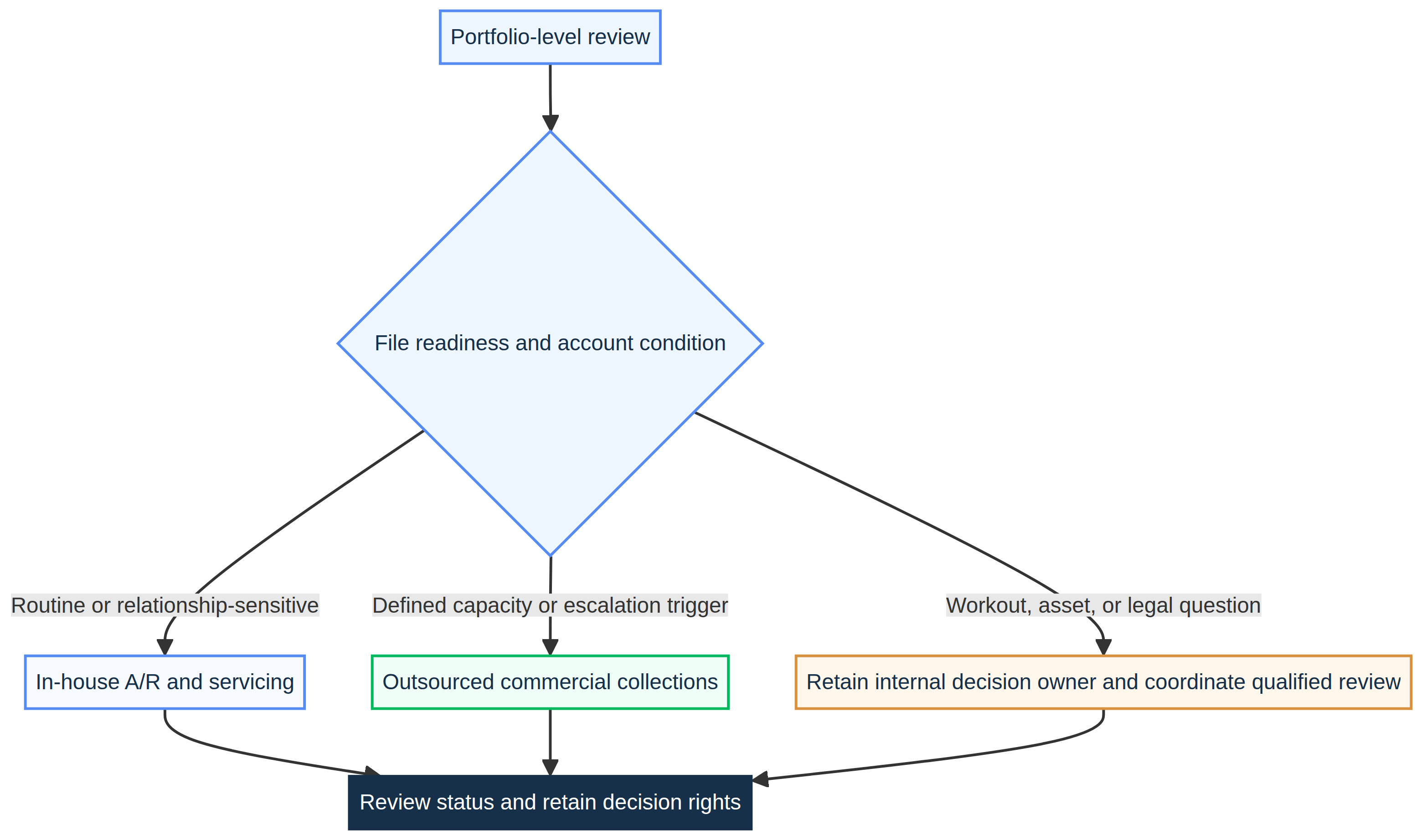
Portfolio-level triage only. The diagram does not prescribe a delinquency threshold, account action, or legal remedy.
A concise triage sequence is:
- Review the account condition using the organization’s own portfolio view.
- Confirm the file is ready and name the internal owner for unresolved issues.
- Keep routine or relationship-sensitive work inside when the team has capacity.
- Move only defined, documented segments to an outsourced commercial workflow.
- Keep workout, asset, or legal questions in a separately governed internal escalation path.
- Review status and retain decision rights across every route.
This vertical article supports—but does not replace—the broader commercial debt collection process and outsourced accounts receivable management guides.
Due diligence questions for a commercial provider
- Can the provider explain relevant commercial equipment-finance experience without unsupported result claims?
- What records are required, and how do missing or unclear files return to the organization?
- Which account stages and actions are in scope, and which remain internal?
- What reporting will management receive, and who can pause, redirect, approve, or close work?
- What are the exact fee, expense, authority, data-handling, and termination terms?
- How will the business coordinate servicing, return information, asset status, or qualified legal review when needed?
For the broader service-evaluation checklist, see commercial debt collection services. A public inquiry should remain organization- and portfolio-level; do not submit account files, payment information, consumer data, or documents.
If a person needs information about an individual account, a dispute path, or communication preferences, use the separate Account Information route. This commercial comparison does not provide account-specific guidance.
Frequently asked questions
Is in-house or outsourced equipment finance collections cheaper?
Neither is automatically cheaper. Compare internal people, systems, oversight, and opportunity costs with a specific written provider scope, fee schedule, authority limits, and reporting requirements. Do not rely on generic percentage claims.
When should a team outsource an equipment finance receivable?
Use an organization-approved trigger, not a universal age band. Consider record readiness, portfolio segment, internal capacity, relationship sensitivity, open questions, and the authorized next path.
Can an outsourced provider handle every account?
An outside provider may support a defined commercial scope, but it should not automatically replace internal servicing, record resolution, decision rights, or specialized legal and asset-related review. A hybrid model often provides clearer control.
What should be ready before an external handoff?
The exact package varies. At minimum, identify the agreement or account record location, billing/payment history, relevant communications, return or asset information when needed, and the internal owner of any open question. Confirm the selected provider’s specific requirements separately.
Conclusion: preserve control at the right point
Equipment finance collections are not an ideological choice between doing everything internally and outsourcing every late account. Keep the work that depends on active commercial context, internal records, relationship ownership, and material approvals close to the organization. Use a specialist commercial workflow only when the file, capacity need, and governance design justify it.
If a business is assessing portfolio-level workflow fit, it can start a commercial placement conversation. Keep that public inquiry at the organization level; do not submit account-level records, payment information, consumer information, or documents.
Sources and limitations
Editorial limitation: This draft makes no universal recovery-rate, cost, fee, legal, licensing, repossession, collateral, state-coverage, or compliance-certification claim. Confirm equipment-finance operating statements with appropriate internal compliance and legal stakeholders before publication.
-
Internal Revenue Service, “Recordkeeping”, last reviewed May 1, 2026; accessed October 8, 2026. Used only for the general importance of business records and supporting documents. ↩
-
JSD Management, “Equipment Leasing Collections for Past-Due Lease Payments, End-of-Term Balances, and Return Disputes”, accessed October 8, 2026. Provider source used only to illustrate possible equipment-leasing record patterns; its placement and outcome statements are not adopted. ↩
-
Intrum, “In-house collections vs. outsourced collections: pros and cons”, published June 15, 2026; accessed October 8, 2026. Provider-led general comparison; European and consumer examples are excluded from this U.S. commercial draft. ↩
-
Atradius Collections, “Accounts Receivable Outsourcing”, accessed October 8, 2026. Provider-led B2B comparison; performance, coverage, cost, DSO, and result claims are not treated as independent evidence. ↩